Boiler & heating breakdowns
Boiler Pressure Relief Valve Leaking: Causes and Fixes
Published
A boiler pressure relief valve leaks for one of two reasons: the system pressure is reaching about 3 bar so the valve opens as designed, or the valve has opened once, picked up grit and no longer reseals. Watching the pressure gauge over a day tells you which, and the cause behind high pressure is usually the expansion vessel or the filling loop.
What the relief valve does, and where you will see the water
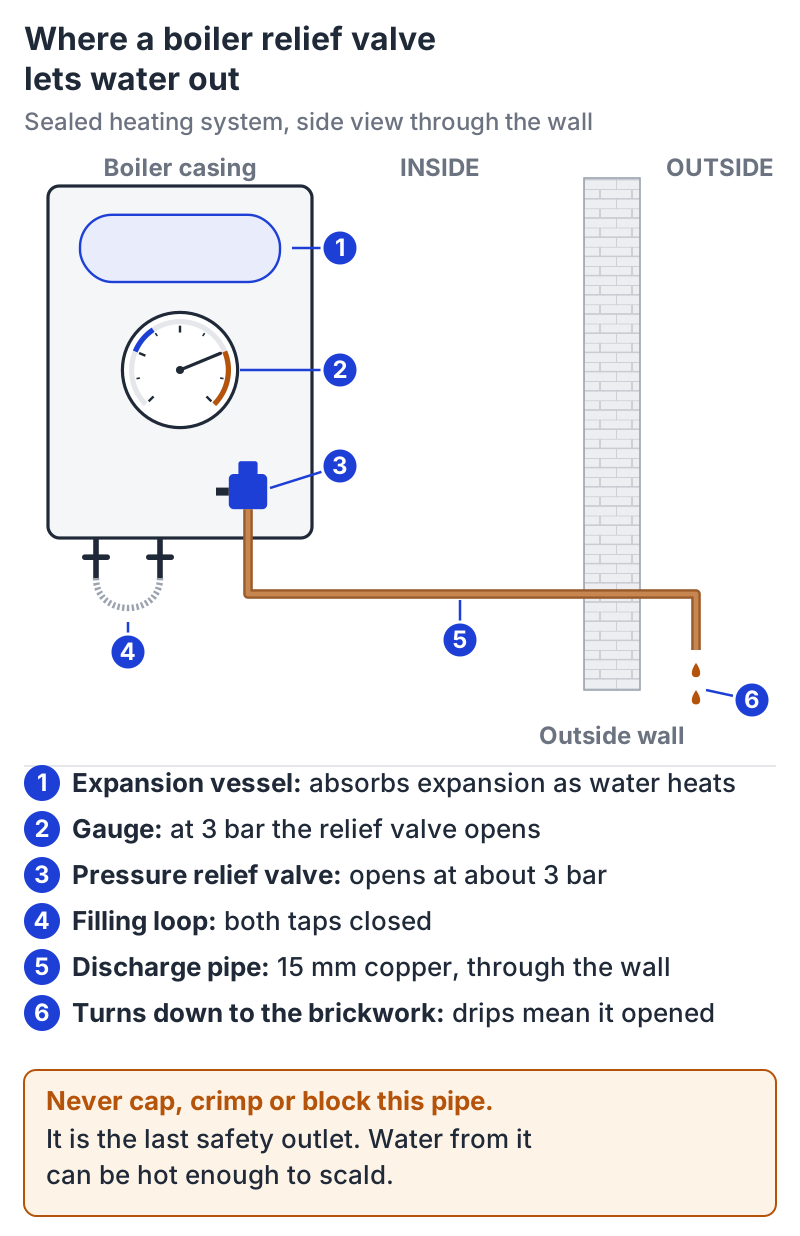
Every sealed heating system has a pressure relief valve, usually inside the boiler casing at the bottom. It is a spring-loaded valve set to open at about 3 bar. If the pressure in the heating circuit reaches that point, it lets water out so nothing else fails.
The water leaves through a discharge pipe, normally 15 mm copper, that runs through the nearest outside wall and turns back down towards the brickwork. That is why many people meet this fault as a copper pipe dripping outside rather than a leak indoors. If the discharge pipe has been cut short inside a cupboard, or the connection has corroded, the water appears under the boiler instead, and a boiler leaking water indoors needs its power off before anything else. Our guide to a boiler overflow pipe dripping outside helps if you are not sure which outside pipe is which.
A relief valve that has opened is a symptom. Replacing it without finding out why the pressure got that high means the new one will be dripping within weeks.
The relief valve sits inside the casing on most boilers. Replacing it means opening the boiler, which is work for a Gas Safe registered engineer.
Keep a one-day pressure log before you call anyone
This is the most useful thing you can do, and it takes nothing more than a pen. Read the gauge on the front of the boiler at these points and write the numbers down:
- First thing in the morning, with the heating and hot water off and the system cold
- After the heating has been running for about 30 minutes
- After running a hot tap for five minutes on a combi, with the heating off
- Last thing at night after the boiler has been off for an hour or two
What your numbers mean
Match your log to the patterns below. Each points at a different part.
Cold pressure around 1 to 1.5 bar, jumping to 2.5 or 3 bar when hot: the expansion vessel has lost its air charge. Heated water expands, and the vessel is the space that absorbs that expansion. When its air cushion has leaked away over the years, there is nowhere for the extra volume to go, so pressure shoots up and the relief valve lifts. A healthy system usually rises by well under a bar from cold to hot.
Pressure creeping up even with the boiler off and cold: water is getting into the sealed circuit from the mains. The usual source is the filling loop, either its taps not fully closed or a valve letting by; on a combi, a leaking plate heat exchanger does the same. Check the loop under the boiler; both taps should be firmly closed and, on a flexible external loop, the hose should be disconnected once the pressure is right, as the water regulations require.
Pressure still rising slowly with the filling loop shut and disconnected on a combi: the plate heat exchanger may have an internal leak that lets mains water, at mains pressure, into the heating side. This one is inside the boiler and needs an engineer.
Pressure normal and stable, but the valve still drips: the valve itself no longer seals. Once a relief valve has opened, even once, sludge or scale can hold it slightly off its seat.
What you can safely do, and what you should not
If the pressure is above 2.5 bar cold, you can bring it down by bleeding a radiator with the heating off and the radiators cold. Put a cloth under the bleed screw, open it a quarter turn with a radiator key, and close it as soon as water comes through. Check the gauge after each radiator. The guide to reducing boiler pressure walks through it.
Make sure the filling loop taps are fully closed. Many high-pressure faults are nothing more than a loop tap left a fraction open after the last top-up.
Do not cap, crimp or block the discharge pipe to stop the drip. The relief valve is the last safety device between the heating circuit and a burst component, and blocking its outlet removes it. Do not try to recharge the expansion vessel yourself either: it needs the pressure on the heating side released to zero, the charge set to the figure in the manual, and on most combis it sits inside the casing.
Some people twist the cap on the valve to flush grit off the seat. Leave that to the engineer: on most boilers the valve is inside the casing, and a valve that has been flushed often keeps weeping anyway.
Hot water from the discharge pipe can scald. If the pipe outside is pouring rather than dripping, switch the boiler off at the fused spur and keep people away from it.
Is it your boiler valve or your hot water cylinder?
If you have an unvented hot water cylinder, usually in an airing cupboard with no tank in the loft, it has its own separate relief valves. These discharge through a tundish, a short open funnel section on the pipe, which lets you see water running. In England, Building Regulations Part G3 requires that arrangement. Water in the tundish points at the cylinder, not the boiler. That is a different fault, covered in our guide to the temperature and pressure relief valve.
What the repair involves and what it costs
On the visit the engineer checks the system pressure, isolates the boiler and releases the pressure on the heating side, then tests the expansion vessel charge with a pressure gauge on its valve. If the charge is low, it is topped up with a pump; if the diaphragm has split and water comes out of the valve, the vessel needs replacing. They also check the filling loop, and on a combi they check whether the plate heat exchanger is letting mains water through. The relief valve is then replaced if it no longer seals.
Typical UK market ranges, parts and labour together: a new relief valve £100 to £200, an expansion vessel recharge often done within the same visit, and a replacement vessel £150 to £450, more if the boiler has to come off the wall. A plate heat exchanger is usually £300 to £600 depending on the make.
Our boiler pressure repair visit has the £60 call-out at any hour, and the repair price is agreed with you on site before any work starts. Gas work is carried out by Gas Safe registered engineers.
Questions people ask
Can I use my boiler if the pressure relief valve is leaking?
For a short time, if the pressure stays between 1 and 2.5 bar and the drip is outside. If the pressure keeps reaching 3 bar, or falls so low the boiler locks out, switch it off and get it looked at.
Why does my relief valve only drip when the heating is on?
Heating makes the water expand. If the expansion vessel has lost its air charge, that expansion pushes the pressure up to about 3 bar and the valve opens. When the system cools, the pressure falls and the drip stops.
Will a leaking relief valve reseal on its own?
Sometimes, if it only opened once and nothing was caught in the seat. More often grit or scale stops it closing fully, and it keeps weeping. If it is still dripping once the pressure is back to normal, it needs replacing.
How long does it take to replace a boiler pressure relief valve?
Usually about an hour, including draining the heating side and refilling. Finding and fixing what caused the high pressure, such as a flat expansion vessel, can add time.