Boiler & heating breakdowns
How to Reduce Boiler Pressure Safely (Step by Step)
Published
To reduce boiler pressure, switch the heating off and let the system cool, make sure the filling loop is fully closed, then open a radiator bleed valve with a cloth underneath and let water out until the gauge reads about 1 to 1.5 bar. Close the valve and recheck an hour later.
What pressure should your boiler be at?
Most combi and system boilers want roughly 1 to 1.5 bar on the gauge when the heating is cold. As the water heats up it expands, so the reading climbs a little while the radiators are hot. That is normal. Many manufacturers mark the working range in green on the gauge.
The number that matters most is 3 bar. That is where the pressure relief valve opens and dumps water through the copper pipe that goes out through the wall. If your gauge is near 3 bar with the heating hot, or at 2 bar or more when cold, it is worth bringing down before the relief valve does it for you.
Check the reading with the boiler cold first. A high reading only when the heating is on, which drops back when it cools, points to a different fault from one that is high all the time. Boiler pressure with the heating on versus off explains the difference.
How to reduce boiler pressure, step by step
You need a radiator key, an old towel or two, and a small container or jug. Allow about 45 minutes, most of it waiting for the system to cool.
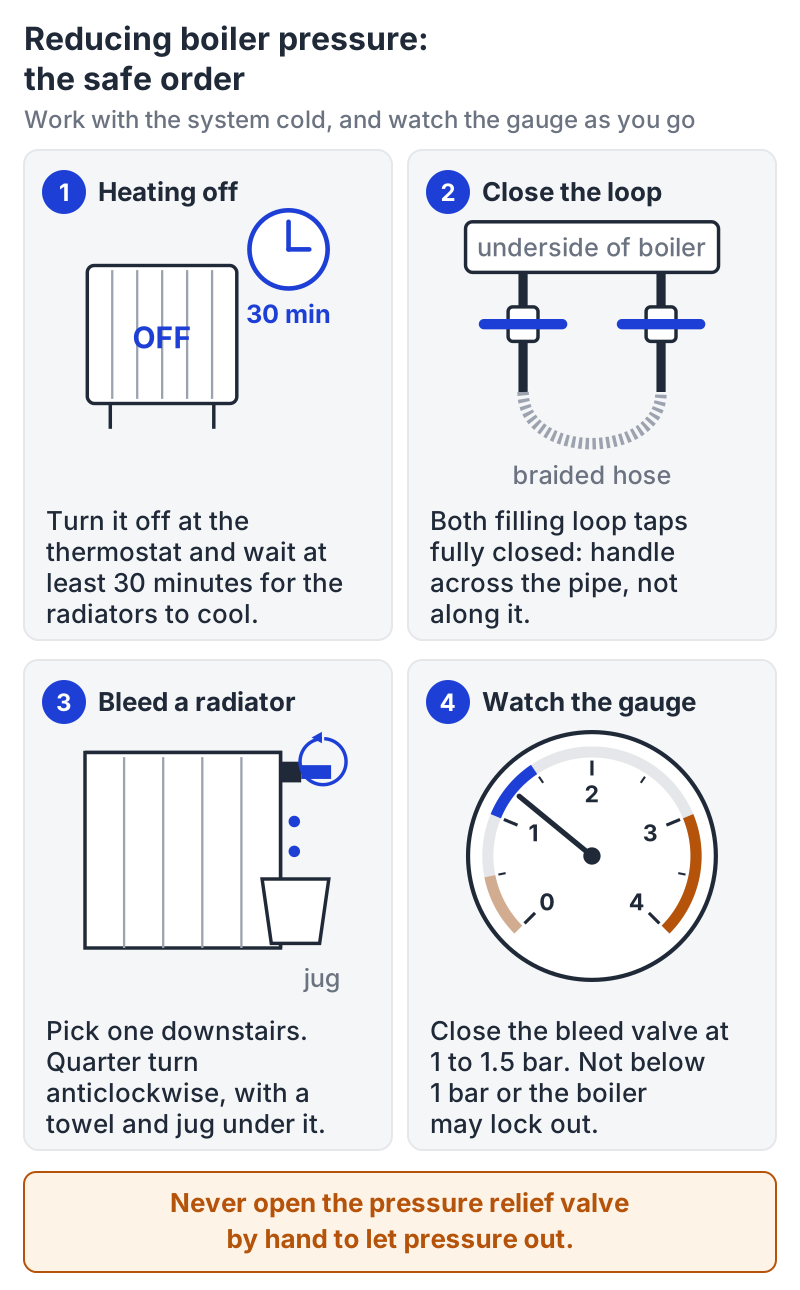
- Turn the heating off at the thermostat or programmer and leave it for at least 30 minutes so the radiators are cool. Hot water spraying from a bleed valve can scald.
- Check the filling loop. This is the braided hose or valve under the boiler that tops up the system. Make sure both taps are fully closed. On boilers with a built-in filling key or lever, check it is in the closed position.
- Pick a radiator, ideally one downstairs. Lower radiators hold water under slightly more pressure, so they release water rather than air.
- Hold a towel and container under the bleed valve at the top corner of the radiator. Fit the key and turn it anticlockwise about a quarter of a turn.
- Let water run out while watching the boiler gauge, or have someone call out the reading. The needle drops quickly, so go in short bursts.
- Close the valve when the gauge reads about 1 to 1.5 bar. Do not go below 1 bar or the boiler may lock out on low pressure.
- Turn the heating back on, let it run for an hour, then check the gauge again with the system hot and later when cool.
Do not open the pressure relief valve by hand to drop the pressure. Once it has lifted, grit on the seat can stop it closing properly, leaving you with a constant drip outside and a boiler that keeps losing pressure.
Other ways to let pressure out
If bleeding a radiator is slow, or the bleed valve is seized, there are two alternatives.
A drain-off valve. Most systems have a drain valve at the lowest point, often on a downstairs radiator valve or on the pipework near the boiler. You attach a hose, run it outside or into a bucket, and open the square spindle with a spanner or a drain key. It lets water out much faster, so open it gently and close it well before you reach 1 bar. Lowering boiler pressure without bleeding radiators covers this method in detail.
Some boilers also have a drain point on the boiler itself. It sits inside or just under the casing on many models, and opening it is not a householder job.
Why does the pressure keep going back up?
If you bring it down and it is back up within a day or two, bleeding is only treating the symptom. Something is either adding water, such as a filling loop that lets by or a cracked plate heat exchanger on a combi, or failing to absorb expansion, which usually means a flat expansion vessel. Our page on boiler pressure too high sets out each cause and the checks that tell them apart.
When you should not do this yourself
Stop and call someone out if water is already pouring from the relief pipe outside, if the gauge is at 3 bar or above and will not come down, if water is coming from inside the boiler casing, or if the boiler is making loud banging or kettling noises alongside the high reading. Pressure that is very high and still rising while the boiler is firing can mean a control or pump fault, and the boiler should be switched off at the fused spur until it is checked.
Do not remove the boiler casing to reach the expansion vessel or any valve inside it. Recharging the vessel means isolating the boiler and releasing its water pressure, and the casing of a gas boiler should only be opened by a Gas Safe registered engineer. Gas work is carried out by Gas Safe registered engineers.
If you smell gas at any point, stop, open the windows, turn the gas off at the meter if you can get to it safely, keep away from switches, and call the National Gas Emergency Service on 0800 111 999 from outside.
What an engineer does about high boiler pressure
The engineer starts by draining the system back to its cold pressure and watching it. A rise with the boiler off points to the filling loop or the plate heat exchanger. A swing only when hot points to the expansion vessel. They check the vessel’s air charge with a tyre-style gauge on its valve, recharge it or replace it, rebuild or replace a leaking filling loop, and replace the relief valve if it has been lifting and no longer seals.
As a typical market guide, an expansion vessel recharge often costs about £80 to £150, and a new relief valve about £90 to £200, including labour. A plate heat exchanger replacement is usually more. For us, the £60 call-out gets an engineer to you at any hour, and the repair price is agreed with you on site before any work starts. See boiler pressure repair for what the visit covers.
Questions people ask
Can I reduce boiler pressure with the heating on?
It is safer to switch the heating off and let the radiators cool first. Water from a hot radiator comes out scalding, and the reading is higher when the system is hot, so you are more likely to let out too much and end up below 1 bar once it cools.
Is 2.5 bar too high for a boiler?
With the heating hot, 2.5 bar is high but below the 3 bar point where the relief valve opens. With the system cold it is too high and should be brought down to about 1 to 1.5 bar. If it keeps returning to 2.5, look at the filling loop and expansion vessel.
Which radiator should I bleed to lower the pressure?
Any radiator will do, but one on the ground floor usually releases water faster and with less air. Bleeding an upstairs radiator is better when you are trying to remove trapped air rather than lower the pressure.
Will high boiler pressure damage anything?
The relief valve is there to protect the boiler by opening at 3 bar, which is why you should never block or cap its pipe. Repeated lifting wears the valve and wastes water, and constant high pressure strains seals and joints over time, so it is worth fixing the cause.
Why is my boiler pressure high after I topped it up?
Usually because the filling loop was left open a little or was closed after the gauge had passed the target. Close it fully and bleed a radiator back down to 1 to 1.5 bar with the system cold.