Toilets, taps & fixtures
Low Level Toilet Leaks and Flush Problems
Published
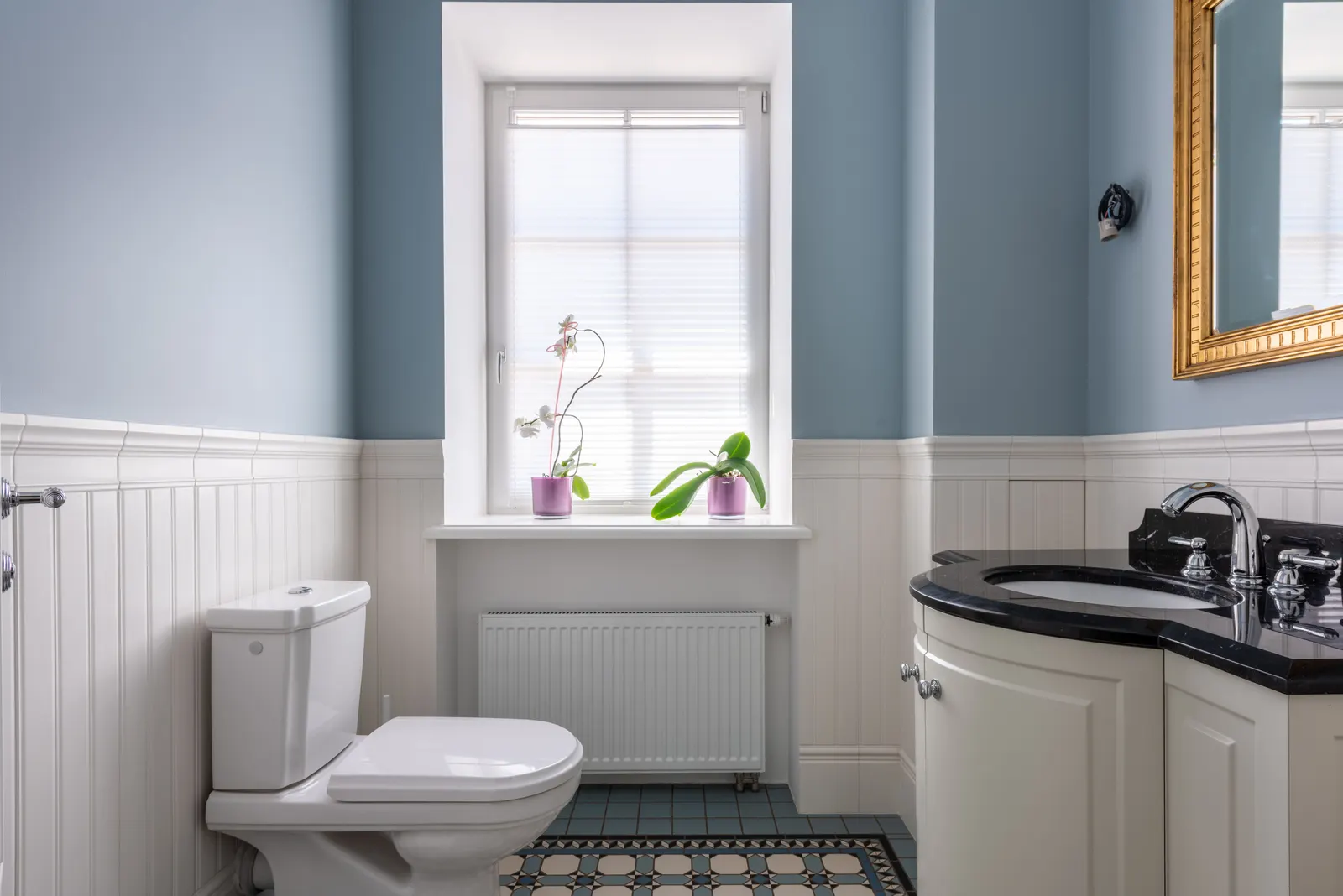
A low level toilet has its cistern fixed to the wall a short way above the pan, joined by a flush pipe. Most faults sit at that pipe: a perished rubber cone leaking at the pan, a loose backnut under the cistern, or a worn siphon diaphragm that needs several pumps to flush. All are repairable.
How a low level toilet differs from a close-coupled one
On a close-coupled toilet the cistern sits directly on the back of the pan. On a low level toilet the cistern is fixed to the wall, usually at around waist height, and a separate flush pipe carries the water down to the back of the pan. A high level toilet is the same idea with the cistern near the ceiling and a long pipe with a pull chain.
That layout adds two joints a close-coupled toilet does not have: one where the flush pipe leaves the cistern and one where it enters the pan. It also means the cistern is held by wall brackets or screws rather than by the pan, and many low level cisterns are older and use a lever-operated siphon rather than a push-button valve. Those three differences explain most of the faults.
Low level toilets are common in older London houses and flats, and they are also still sold new, often with a slim plastic or ceramic cistern and a chrome flush pipe for a period look. The faults below apply to both.
Leaking at the pan end of the flush pipe
Water on the floor at the back of the pan, only during a flush, is most often the flush pipe connector. The flush pipe pushes into the pan's inlet horn and is sealed by a rubber cone, sometimes called a flush cone or flush pipe connector. The rubber hardens and shrinks with age, and a knock to the pan or the pipe opens a gap. Each flush forces water past it.
To check, dry the joint and flush with a sheet of kitchen roll wrapped round it. A wet sheet confirms it. A new cone costs a few pounds at a plumbers' merchant, but check the flush pipe diameter first: most are 38mm (1½ inch), yet older installations vary. To fit it, the flush pipe is eased out of the pan, the old cone is cut off, the new one is pushed onto the pipe and folded back over the pan horn. Soap on the rubber helps. Do not use silicone in place of a cone; the joint moves every flush.
If the leak is clean water but is at the back of the pan at floor level, not at the flush pipe joint, it is more likely the pan connector to the soil pipe. That is a different repair, covered in toilet pan connector leaking.
Leaking under the cistern
A drip from under a low level cistern points to the joint where the flush pipe meets the cistern outlet. The outlet of the siphon or flush valve passes through the base of the cistern and is held by a large plastic backnut with a washer. The flush pipe then connects to it with a nut and a tapered washer. Any of these washers can fail, and the backnut can work loose because the flush pipe acts as a lever every time someone knocks it.
Also check the water feed. On a low level cistern it often enters at the side through a ball valve, with its own backnut and washer, and a leak there drips whether or not the toilet is flushed. That is the same fault as on any cistern, and how to repair a leaking toilet cistern covers the washer change.
Turn off the isolation valve and drain the cistern before touching the outlet backnut. Hand tight plus a small turn is enough on plastic. If the cistern itself is cracked, often at a screw hole from being fixed too tightly to an uneven wall, it needs replacing.
Low level toilet not flushing properly
Many low level toilets use a siphon: a plastic chamber in the cistern with a lifting plate at the bottom covered by a flexible diaphragm, often called the flap valve. Pressing the lever lifts the plate, the diaphragm pushes water up and over the siphon, and the siphon then drains the cistern. When the diaphragm splits or stiffens, it lets water slip past instead of lifting it, and the flush fails to catch. If the siphon turns out to be sound, the bucket test for a weak flush shows whether the cistern or the drain is to blame.
The telltale sign is needing to pump the lever two or three times, or hold it down, before the toilet flushes. A replacement diaphragm costs little, but the siphon has to come out to fit it, so the cistern is drained and the flush pipe disconnected. Take the old diaphragm to match its size, or replace the siphon complete if it is old and brittle.
- Lever moves but nothing happens: the wire or link from the lever to the lifting plate has broken or come unhooked. Lift the lid and check first; it is often a two-minute fix.
- Flush starts then stops early: the water level is set too low. Raise the float until the water reaches the level mark.
- Several pumps needed every time: the siphon diaphragm is worn.
- Weak flush that does not clear the pan, with a normal cistern: a partial blockage in the pan or drain, or a flush pipe that is misaligned at the pan horn.
Running water and overflow on older cisterns
Older low level cisterns often have a side-entry ball valve with a float on an arm, and an overflow pipe through the wall. When that valve washer wears, water runs into the overflow and drips outside, which is the fault described in toilet overflow pipe leaking. A siphon cistern rarely leaks into the pan, because a siphon only passes water when it is primed. So a low level toilet that trickles into the bowl constantly is usually overflowing internally or has a push-button valve with a worn seal.
A replacement ball valve must suit the supply. Valves are made for high or low pressure, and the wrong one either fills very slowly or will not close. Many modern replacements work across the range, but check the packaging before buying.
Repair or replace?
Low level toilets are very repairable. Cones, washers, siphons and valves are all stock parts, and a repair keeps a period cistern and pipe that can be hard to match. Replacement is worth considering if the cistern is cracked, the siphon is an unusual shape that no longer has spares, or the wall is being tiled and a close-coupled layout would suit the room better. Reproduction period sets with chrome pipes and ceramic cisterns cost considerably more than a basic suite, before fitting is added.
An engineer diagnoses the leak or flush fault, replaces the cone, washers or siphon, sets the water level and aligns the flush pipe so it does not strain the pan joint. Across the London market, a flush pipe cone, siphon or valve replacement on a low level toilet typically costs between £80 and £180 including parts. With us, the visit is a £60 call-out at any hour, and the repair price is agreed with you on site before any work starts. Book a toilet repair if the leak or flush fault is beyond a simple adjustment.
Questions people ask
What is a low level toilet?
A toilet whose cistern is fixed to the wall a short distance above the pan, with a flush pipe connecting the two. It sits between a close-coupled toilet, where the cistern rests on the pan, and a high level toilet with the cistern near the ceiling.
Why does my low level toilet leak only when I flush?
Because the flush pipe only carries water during a flush. A leak that appears only then is almost always the rubber cone at the pan end of the flush pipe or the washer where the pipe joins the cistern outlet.
Can a low level cistern be converted to a push-button flush?
Often yes. Many low level cisterns can take a modern push-button flush valve in place of the siphon, provided the outlet hole and cistern depth suit. It is usually done when the siphon needs replacing anyway.
Why do I have to pump the lever several times to flush?
The diaphragm on the siphon lifting plate is worn and lets water slip past instead of lifting it over the siphon. Replacing the diaphragm, or the whole siphon, restores a single-press flush.