Toilets, taps & fixtures
Toilet Leaking From the Base: Pan, Seal or Crack?
Published
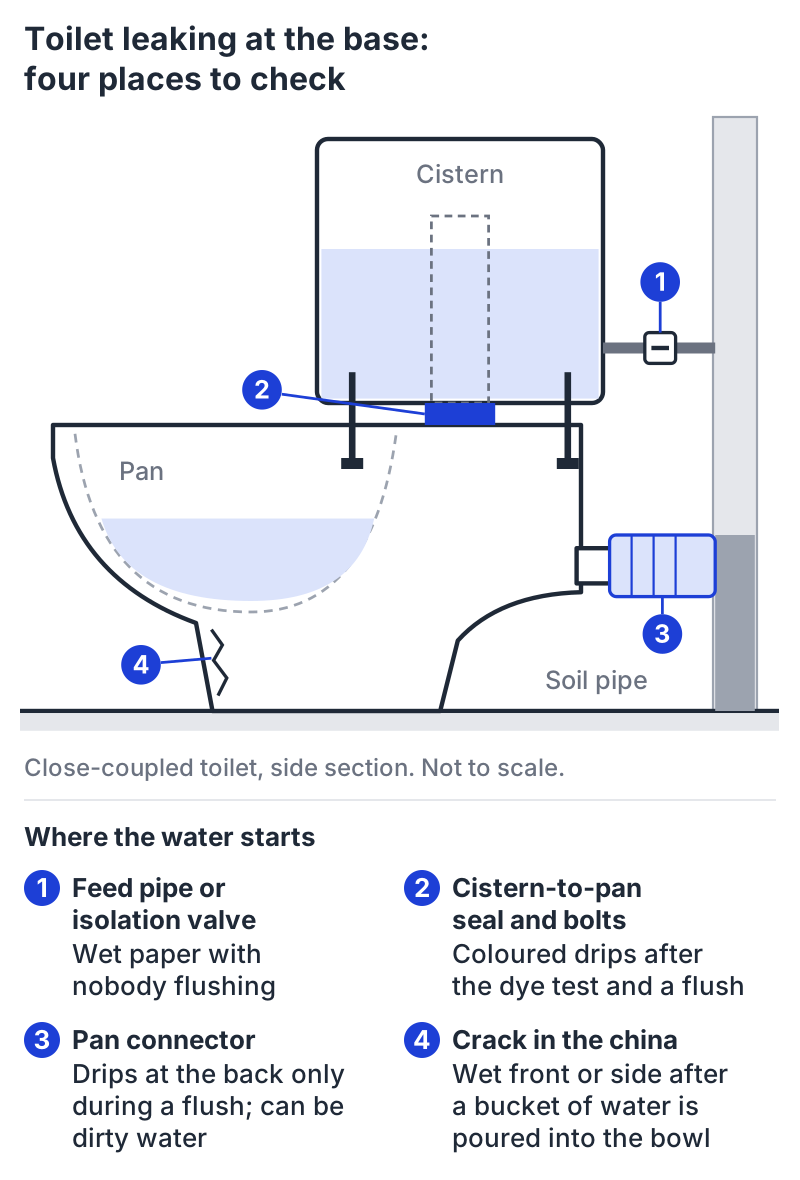
A toilet leaking from the base or bowl is almost always one of three things: the seal between the cistern and the pan, the connector where the pan joins the soil pipe, or a crack in the china. Dry paper, food colouring and a bucket of water tell you which. Only a cracked pan needs replacing.
Leaking at the base when nobody has flushed: condensation, pipe or cistern?
Before taking anything apart to fix a leaking toilet, rule out the two things that look like a leak and are not. The first is condensation. Mains water arrives cold, and in a steamy bathroom the outside of the cistern and pan sweats. The drops run down to the floor and gather behind the pedestal, which looks exactly like a slow leak. If the whole outer surface feels damp and beaded, and the puddle gets worse after a bath or shower rather than after a flush, it is condensation. Better ventilation fixes it; no part does.
The second is splash and overspill from the pan itself, especially around a close-fitting seat. Wipe everything dry, including the floor and the back of the pedestal, and lay a few sheets of dry kitchen roll around the base and under the back of the cistern. Paper shows the first drop and where it lands, which a wet floor never will.
Also check the pipework before blaming the toilet. A dripping isolation valve or a weeping compression nut on the cistern feed runs down the pipe and onto the floor behind the pan. That leak is there whether or not anyone flushes, and it is covered in our guide to a toilet leaking from the back pipe.
If the surfaces are dry to the touch and the feed pipe is dry, but water still gathers at the base with nobody flushing, look at the cistern. Its bolt washers and body hold water all the time, so they leak around the clock; the first of the tests below confirms it.
Four tests that find the leak
Each test puts water through one more part of the toilet. The first one that wets the paper tells you the source.
- Leave the toilet unused for 30 minutes. Wet paper under the cistern with nobody flushing means the feed connection, the washers on the cistern bolts or the cistern body. These are under water all the time, so they leak around the clock.
- Add a few drops of food colouring to the cistern, wait ten minutes, then flush once. Coloured drips from the joint between cistern and pan, or on the paper under the pan shelf, mean the cistern-to-pan seal. Clear water on the floor instead points back to the feed pipe or condensation.
- Flush and watch the back of the pan at floor level. A drip that appears only during the flush, at the back where the pan meets the waste pipe, is the pan connector.
- Pour a bucket of water into the bowl by hand, so the cistern plays no part. If water appears at the front or side of the pedestal with nothing at the back joint, suspect a crack in the pan.
If the water is coming through the ceiling of the room below, turn off the isolation valve on the cistern feed now and stop using the toilet until the source is found. See a ceiling leak below the bathroom.
Toilet bowl leaking from the tank
Most UK toilets are close-coupled: the cistern sits on the back of the pan and is held by two bolts through the pan shelf. Water passes down through a large rubber or foam washer, usually called the doughnut, into the pan. Two smaller washers seal the bolt holes. When any of these harden or the bolts corrode, water escapes every time the cistern empties and runs along the underside of the pan shelf before dropping to the floor.
This is the most common reason a toilet bowl leaks from the tank, and the dye test catches it. Tightening the bolts sometimes stops a small weep, but only by a quarter turn at a time and evenly on both sides. Overtightening the nut against vitreous china is how cisterns crack, and a cracked cistern turns a slow leak into a flood.
The lasting repair is to isolate the water, empty the cistern, lift it off, fit a new doughnut washer and bolt kit, and refit it level. The parts cost a few pounds from any plumbers' merchant, typically £5 to £15 for a washer and bolt set, though you need the one that matches your flush valve outlet. Some brands use their own shape of seal, so take the old one with you. Our guide to a leaking toilet cistern covers leaks from the cistern body itself.
The pan connector at the back
The outlet at the back of the pan pushes into a pan connector, a plastic or rubber sleeve with fins that grip the pan and seal it to the soil pipe. Older installations may have a cement or putty joint instead. A connector leaks when the pan has been knocked or has moved, when the fins have aged and lost their grip, or when a partial blockage further down makes waste back up and press against the joint.
A connector leak can carry waste, not just clean flush water. Treat the floor as contaminated, keep children and pets away, and clean it with disinfectant. If the drip gets worse when the pan fills higher than usual, the problem may be a blockage rather than the connector. Our guide to a leaking pan connector goes through that difference in detail.
Replacing a connector means lifting or sliding the pan forward, so on a close-coupled toilet the cistern has to be disconnected from the supply and often lifted off too. The part itself is cheap, commonly £5 to £20, but the labour is the job: unscrewing the pan from the floor, cutting away old sealant and aligning everything back so the new connector is not under strain.
When the pan itself is cracked
Toilet pans are vitreous china and do not flex. A crack starts from a knock, an overtightened floor screw, a heavy object dropped in the bowl or the house settling under an uneven floor. A hairline crack below the water line leaks slowly all the time. One above the water line leaks only during a flush, when the water level rises past it. Run a dry finger along the pedestal and the trap moulding; a fine grey line that stays wet after drying is the usual sign.
No sealant or epoxy repair lasts on a pan that carries water under movement, and a crack can grow suddenly. The fix is a new pan. Where the cistern and pan are sold as a pair, you may need the matching cistern too, because the bolt spacing and the doughnut seat differ between models. A basic replacement pan is commonly under £100 at merchants, while a designer close-coupled set can run to several hundred, plus fitting.
Stop using a toilet with a crack that weeps from the trap area. If the pan gives way under weight, it can break into sharp pieces and empty the trap, and anything in it, onto the floor.
What an engineer does, and what it costs
An engineer runs the same tests quickly, then removes any boxing or panel that hides the pipework to confirm the source. For a cistern-to-pan seal, they isolate the supply, empty and lift the cistern, fit the new doughnut and bolts, reseat it and test it with several flushes. For a connector, they unfix the pan, fit a new connector and refix the pan so it does not rock. For a cracked pan, they can often fit a replacement on the same visit if a standard model suits your cistern.
Across the London market, replacing a doughnut seal or a pan connector usually sits somewhere between £80 and £180 including parts, depending on access and how the pan is fixed. A new pan fitted runs higher because of the part. With us, the visit is a £60 call-out at any hour, and the repair price is agreed with you on site before any work starts. Book a toilet repair if the leak is under the cistern or at the connector, or toilet unblocking if the pan is backing up.
Questions people ask
Is a leaking toilet bowl an emergency?
A drip only during a flush can usually wait a day if you mop it and flush less. It becomes urgent when water is reaching the ceiling below, when the leak runs with nobody flushing, or when it is dirty water from the pan connector. Close the isolation valve on the feed if in doubt.
Why does my toilet leak only when I flush?
A leak that shows only during a flush comes from something that carries water only then: the cistern-to-pan seal, the pan connector at the back, or a crack above the normal water line. The food colouring test and the bucket test separate them.
Can I use silicone to seal a leaking toilet bowl?
Silicone around the base does not stop a leak; it hides it and lets water spread under the floor. It will not seal a failed doughnut washer or pan connector either, because they are compression and push-fit seals that do not work by adhesion. Replace the part that has failed.
Can a cracked toilet pan be repaired?
Not reliably. China under load and constant water will keep opening along the crack, and a repair can fail without warning. Replace the pan, and check it matches your cistern if the two are a close-coupled pair.