Water supply problems
What Does a Stopcock Look Like?
Published
A stopcock usually looks like an old-fashioned tap with no spout: a brass or chrome body sitting in a straight run of pipe, a T-shaped or round handle on top, and an arrow cast into the body. Newer ones may be a lever valve instead. It sits on the cold main where it first comes into your home.
The classic stopcock: a tap with no spout
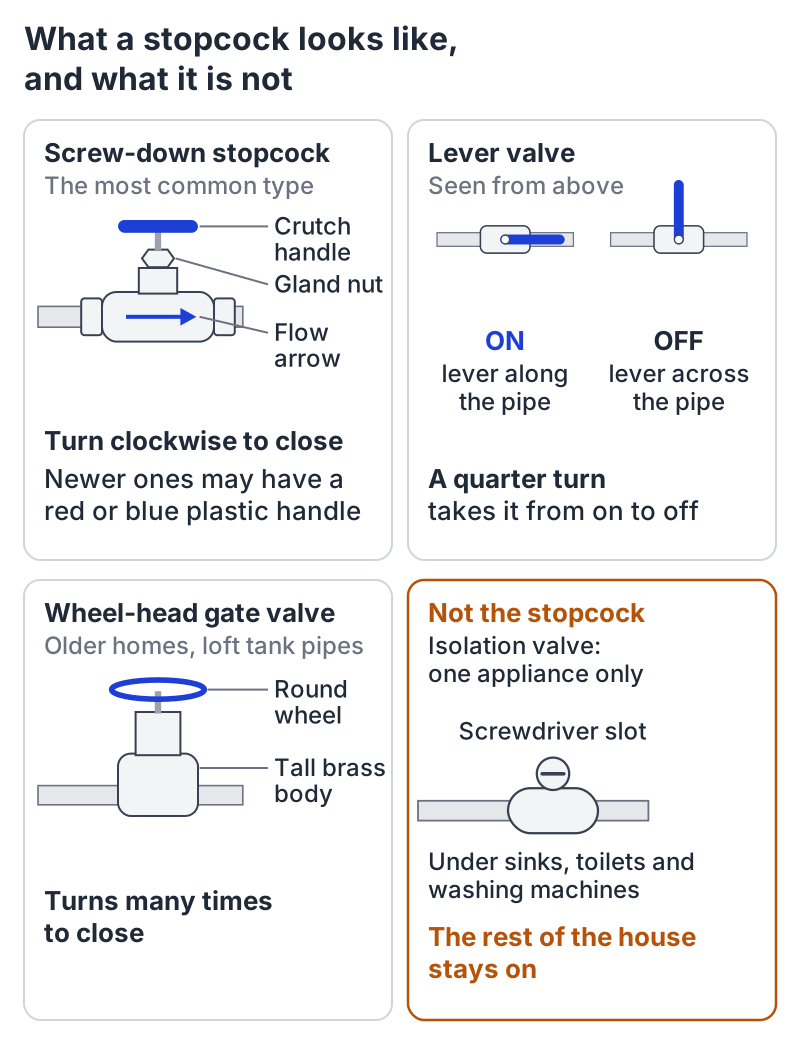
The traditional stopcock found in most British homes is a screw-down valve. Picture the top half of an outside tap, then imagine the pipe going straight in one side and straight out of the other. The body is usually bare brass, sometimes chrome-plated, and roughly the size of a matchbox. On top is a spindle with a handle, which is either a small T-shape (plumbers call it a crutch head) or a round wheel. Older ones have a metal handle; newer ones often have a red or blue plastic handle.
Look closely at the body and you will usually see an arrow cast or stamped into the metal. The arrow shows which way the water flows, from the supply towards your taps. A screw-down stopcock only works properly one way round: fitted backwards, the loose jumper inside can sit on its seat and restrict the flow even with the handle open, so the arrow is a quick check that it was put in correctly. You may also see a size stamp, usually 15 or 22, which is the pipe diameter in millimetres.
Under the handle there is a hexagonal nut called the gland nut. It holds the packing that stops water weeping out around the spindle. If you ever see a drip from just under the handle, that is where it is coming from.
Other shapes a stopcock can take
Not every home has the classic brass valve. What you are looking for is any valve on the cold pipe that comes up through the floor or in through a wall, before it branches off to anything else. It can look like any of these.
- A lever valve: a straight body with a flat lever on top, often red or blue. When the lever runs along the pipe, the water is on. A quarter turn so the lever sits across the pipe turns it off.
- A plastic-bodied stopcock: common where the incoming pipe is blue plastic (MDPE). The body is black, grey or blue plastic with compression nuts at each end.
- A wheel-head gate valve: a round wheel on a taller brass body, often found in older properties and on pipes in loft tanks. It turns many times before it closes.
- A combined stopcock and drain valve: an ordinary stopcock with a small extra nut on one side, which lets the pipework be drained once the water is off.
- A remote switch: some homes have a stopcock hidden behind a panel with a switch or push button on the wall. Surestop is one well-known make. It shuts the water with a flick rather than a turn.
Stopcock or something else? How to tell the valves apart
Kitchens and bathrooms are full of small valves, and most of them are not the stopcock. The mistake that costs people most in a leak is turning a small isolation valve and thinking the whole house is off. These are the lookalikes.
- Isolation valves: small chrome or brass barrels, usually under a sink, toilet or on a washing machine pipe, with a slot for a flat screwdriver or a tiny butterfly handle. They shut off one appliance only. See a leaking isolation valve if one of them is dripping.
- Washing machine valves: a small lever tap on a pipe, usually with a blue or red handle, and a threaded outlet for the machine hose.
- Drain-off cocks: a small nozzle with a square or hexagonal head and a hose outlet, fitted low on pipes to empty them. They let water out rather than stop it.
- Boiler valves: valves on the pipes underneath a boiler control heating water, gas or the filling loop. The gas valve usually has a yellow handle. Leave all of these alone when you are hunting for the stopcock.
- Gas meter valve: the lever on the pipe next to your gas meter. It controls the gas supply and has nothing to do with water.
If you smell gas at any point, open windows and turn the gas off at the meter if it is safe to reach. Do not use electrical switches or naked flames. Leave the property and call the National Gas Emergency Service on 0800 111 999.
Where it is likely to be, and how to be sure it is the right one
The stopcock is normally fitted where the cold main enters the building, which in most houses means under the kitchen sink, because the kitchen cold tap was traditionally the first drinking point. In older London terraces it is often in the cellar, under the stairs, or under a floorboard near the front door. Flats are a different story; our guide to the stopcock in a flat covers risers, cupboards and communal valves. For every place worth checking, in order, see where to find your stopcock.
Once you have found a valve that looks right, prove it before you need it. Turn on the kitchen cold tap, then turn the valve clockwise until it stops. If the tap slows to a trickle and stops within a few minutes as the pipes drain, you have the right valve. Turn it back anticlockwise fully, then back a quarter turn so it does not seize open. If the tap keeps running, you have found an isolation valve or a valve on a different branch, and the real stopcock is further back along the pipe.
It helps to tie a luggage label to it once you know. Anyone in the house can then find it in the dark in the first minute of a burst.
What a stopcock looks like when it needs replacing
A stopcock that has sat untouched for years often shows it. Green or white crusty deposits around the gland nut mean it has been weeping slowly. A handle that spins without shutting the water means the spindle or the jumper inside has failed. A handle that will not move at all, even with firm hand pressure, has seized. None of these will stop the water when you need them to.
Do not force a seized stopcock with a wrench. On old lead or thin copper pipe you can snap the pipe or crack the body, which turns a non-urgent job into a flood with no way to stop it. Our guide to a stopcock that won’t turn goes through the gentle ways to free one, and when to leave it.
Replacement is a routine job. A new brass stopcock costs roughly £5 to £25 as a part, and a plumber fitting one usually needs the water off at the outside stop tap for about an hour or less. The awkward cases are old lead pipe, a valve buried in a wall, or an outside stop tap that will not close either. For those, see stopcock repair.
Typical market part prices, for guidance only. The repair price is agreed with you on site before any work starts.
The other stopcock: the one outside
There is usually a second valve that controls your supply, in a small chamber under a cover in the pavement or front garden. It looks different from the one inside: a brass or plastic valve at the bottom of a narrow pipe or pit, often a foot or more down, with a square top or a small crutch handle that needs a long stop tap key to reach. It often shares the chamber with the water meter, which is covered in where the water meter is.
That outside valve normally belongs to the water company, and the supply pipe from your property boundary into your home is normally yours. It is useful to know it exists, but it is the last resort, not the first. Our guide to the external stopcock explains when you can use it and how to do it without damaging it.
Questions people ask
What colour is a stopcock?
Most are bare brass, so a dull gold or brown colour, sometimes turned green with age. Many have a red or blue plastic handle. Plastic-bodied stopcocks on blue MDPE pipe are usually black, grey or blue. Colour alone will not tell you, so check that the valve is on the incoming cold pipe before any branches.
Is a stopcock the same as a stop tap?
Yes. Stopcock, stop tap, stop valve and main water valve are different names for the same thing. Some people use stop tap for the valve outside and stopcock for the one inside, but either name is correct.
Which way do you turn a stopcock to turn the water off?
Clockwise, as you look at the handle from above. A lever type needs a quarter turn so the lever sits across the pipe. Our guide on how to turn off a stopcock covers stiff valves and what to do next.
Can I have more than one stopcock?
Yes. Larger houses, conversions and homes that have been extended often have a second valve on a branch to a kitchen extension, a garage or an upstairs flat. The one that matters is the first valve after the pipe enters the building, because it controls everything downstream.