Hot water problems
Hot Water Only Lukewarm From a Combi
Published
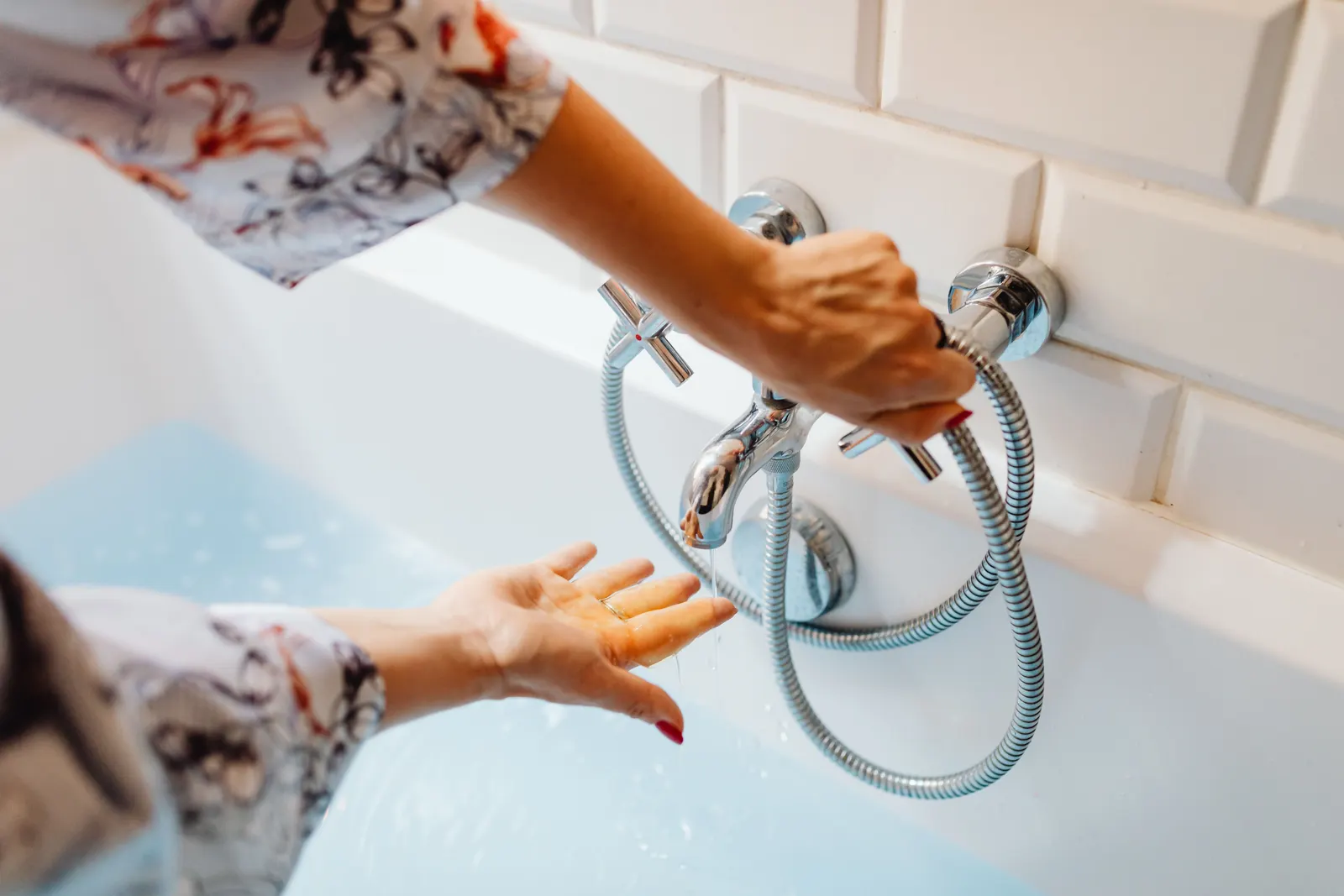
When combi boiler hot water is lukewarm, the boiler cannot add enough heat to the water flowing through it. Turn the tap to half flow: if it gets hot, the boiler is at its limit for that flow, which is common in cold weather. If it stays lukewarm, suspect a scaled plate heat exchanger, a passing diverter valve or low gas pressure.
Try this first: slow the tap down
A combi heats water as it passes through, so how hot it gets depends on how fast it flows. Engineers use a simple rule: output in kW is roughly the flow in litres a minute, times the temperature rise, times 0.07.
Take a common 24kW combi running a bath tap at 10 litres a minute. That gives a rise of about 34°C. In August, when the mains comes in at around 15°C to 20°C, that is water at about 50°C, which feels properly hot. In a cold January, with the mains near 5°C to 8°C, the same boiler and the same tap give about 40°C, which feels lukewarm.
So open a hot tap fully, then close it down to about half. If the water gets noticeably hotter, the boiler is working and you are asking more of it than its output allows. That is a sizing limit, not a fault. If the water stays lukewarm even at a trickle, something is wrong.
Other checks that cost nothing
All of these are on the outside of the boiler or around the house. None needs a tool.
- Hot water temperature setting: check the tap symbol dial or menu has not been knocked down. Most combis go up to around 60°C on hot water.
- Eco, comfort or preheat modes: on many combis, Worcester Bosch among them, an eco setting turns off preheat, so the first water takes longer to warm up. It should still reach full heat after a minute or so.
- Radiators while the tap runs: with the heating off, run a hot tap for five minutes, then feel a radiator. If it is warming up, the diverter valve is sending part of the heat the wrong way.
- One outlet or all: try the kitchen tap, the basin and the bath. If only the shower is lukewarm, the fault is its thermostatic valve, not the combi.
- Other gas appliances: if the gas hob is weak as well, the gas supply is the problem.
- Pressure gauge: most combis want about 1 to 1.5 bar cold. Low pressure causes its own faults, and our guide to boiler pressure repair covers topping it up.
Do not turn the hot water setting to maximum and leave it there with children or older people in the house. The higher the setting, the faster water at the tap can scald, and children and older people burn fastest. Set it back once the fault is fixed.
Lukewarm even at a trickle: the four usual faults
If slowing the tap does not bring the heat back, one of these is almost always the cause. They are listed roughly in the order engineers find them.
A scaled plate heat exchanger. London is a hard water area and limescale lines the small plate heat exchanger over the years. The scale insulates the plates, so less heat reaches the tap water. Early on, the water is lukewarm at high flow and fine at low flow. Later, the boiler starts overheating and cutting out on hot water. A slow decline over months is the giveaway.
A passing diverter valve. The diverter should send all the heat to the plate heat exchanger when a tap is open. When its seal or cartridge wears, some of that heat leaks through to the radiators. The tap gets warm, not hot, and the radiators warm up in summer. Our guide on a boiler heating radiators but not water covers the fully stuck version of the same fault.
The boiler is not reaching full output. A combi turns its burner up and down to suit the demand. If the gas supply pressure drops when the boiler asks for full power, or the gas valve or fan is not ramping up, the boiler runs at part output and the water never gets hot. An undersized gas pipe between the meter and the boiler is a common cause after a combi has been swapped for a bigger one.
A faulty hot water sensor. If the thermistor on the hot outlet reads higher than the real temperature, the boiler turns the burner down early because it thinks the water is already hot enough.
Lukewarm at one tap only
If the kitchen is hot but the shower is lukewarm, the combi is fine. Thermostatic shower valves mix hot and cold through a cartridge that scales up, and a worn cartridge often settles on lukewarm whatever you set it to. A new cartridge is usually a straightforward swap.
A single-lever mixer tap can do something similar. If its cartridge is worn, cold water crosses into the hot side inside the tap, so the tap never runs fully hot. If the problem is only at one shower, our guide on no hot water to the shower goes through it.
What the engineer does
The engineer measures two things at a hot tap: the flow rate, with a flow cup or a timed jug, and the temperature, with a probe. Comparing them against the boiler output tells them straight away whether the boiler is delivering what it should. If it is, the answer is a lower flow or a flow restrictor, not a repair.
If the boiler is short of output, they check the gas working pressure at the meter and at the boiler inlet with the boiler at full rate. The meter should hold at around 21 millibars, and the pipe to the boiler should lose no more than about 1 millibar on the way. A big drop means the pipe is too small, which is a pipework job rather than a boiler part. Gas work is carried out by Gas Safe registered engineers.
If gas and output are fine, they check whether the radiators warm up while the tap runs, pointing to the diverter, and check the temperature rise across the plate heat exchanger for scale. A sensor is tested against a thermometer reading.
What getting it fixed usually costs
Our visit is the £60 call-out, and the repair price is agreed with you on site before any work starts. You can check what a call-out costs, and the no hot water repair service covers lukewarm water as well as none at all. For budgeting, these are typical UK market ranges, parts and labour together.
- Hot water thermistor: typically about £80 to £180
- Diverter valve cartridge or motor: typically about £200 to £450
- Plate heat exchanger: typically about £300 to £700
- Shower valve cartridge: typically about £80 to £200
- Scale reducer fitted on the cold inlet: usually one of the smaller jobs, and worth it after a new plate heat exchanger
If a combi is more than about 12 years old and needs a plate heat exchanger and a diverter valve at the same visit, ask for both prices before agreeing. Sometimes the numbers point towards replacement instead, and the engineer can tell you where the line sits for your model.
Questions people ask
Why is my combi hot water lukewarm in winter but fine in summer?
The mains comes in colder in winter, often below 8°C, so the boiler has more work to do for the same flow. A combi that gives hot water in summer can give lukewarm water in January at the same tap. Running the tap a bit slower usually fixes it.
Will turning the hot water temperature up fix lukewarm water?
Only if it had been turned down. If the boiler is already at its normal setting and the water is lukewarm, the limit is output, scale or a faulty part, and turning the dial up will not add heat the boiler cannot deliver.
Can I descale a combi boiler myself?
No. The plate heat exchanger is inside the casing, and getting to it means opening the boiler, which is work for a qualified engineer. Leave it to an engineer, who can decide whether a flush will work or a new plate is the better repair.
Is lukewarm hot water a sign of a dangerous boiler?
Usually not. It is normally a heat transfer or output fault. It is only a safety issue if it comes with a gas smell, fumes, sooty marks or feeling unwell. In that case open windows, turn the gas off at the meter if you can reach it safely, get outside and call 0800 111 999.