Water supply problems
Low Pressure at the Kitchen Tap Only
Published
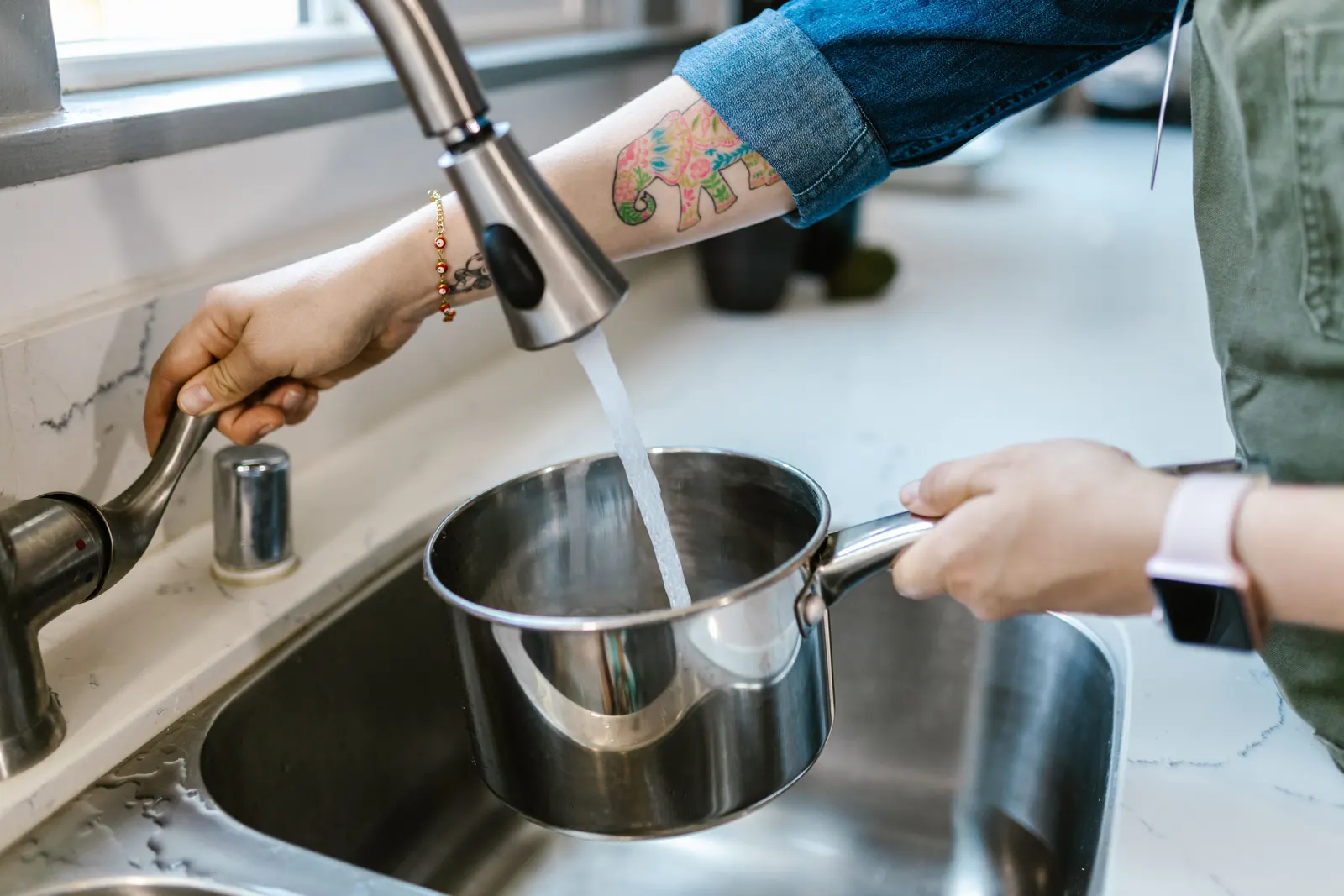
Low pressure at the kitchen tap, when the rest of the house is fine, is almost always caused within a metre of the tap: a scaled-up aerator, a half-closed isolation valve under the sink, a kinked flexible hose or debris in the tap cartridge. Check them in that order. Most take ten minutes and no special tools.
First, is it really only the kitchen?
Two quick comparisons tell you where to look, and save you taking apart a tap that is not at fault.
Run another mains-fed cold tap fully, such as the outside tap or the bathroom basin if you have a combi or unvented cylinder. If it is strong and the kitchen cold is weak, the problem is local to the kitchen. If the bathroom is weak too, the problem is further back: a partly closed stopcock, a failing supply pipe, or low pressure in the street. Our guide to low water pressure in your area covers that side.
Then compare the kitchen hot and cold. On a mixer tap, open it fully to cold, then fully to hot. If only the hot is weak, the cause is usually on the hot water side: the boiler, cylinder or a gravity-fed hot supply. That has its own guide on low pressure from the hot tap only. If both hot and cold are weak at the kitchen tap alone, the tap itself is the prime suspect.
A simple measure helps too. Hold a one-litre jug under the tap, open it fully and time how long it takes to fill. Do the same at the bathroom basin. A kitchen that takes twice as long as the basin, on the same cold supply, has a restriction somewhere in the last few feet.
The five causes, in the order to check them
Work through these from the outlet backwards. The first two account for most cases.
- A blocked aerator. The small mesh insert in the end of the spout catches limescale and grit. London water is hard, so it scales up within months. Unscrew it (by hand, or with the small plastic key that came with the tap), soak it in white vinegar for an hour, rinse and refit.
- A half-closed isolation valve. Under the sink, each flexible hose usually has a small valve with a screwdriver slot. When the slot runs along the pipe, it is fully open. Across the pipe, it is shut. Anything in between throttles the flow. People often turn these while fitting a dishwasher and never open them fully again.
- A kinked or collapsed flexible hose. Braided tap hoses can kink behind a bin or when the cupboard contents are pushed back. Some hoses also have a small filter mesh at the top, where they screw into the tap, which clogs with debris after water works in the street.
- A blocked tap cartridge. Single-lever mixers use a ceramic cartridge, typically 35mm or 40mm. Grit from the mains can lodge in the tiny inlet holes. Many two-handle taps use quarter-turn ceramic disc headgear, which can block the same way.
- An under-sink filter or softener unit. If the kitchen tap is fed through a drinking-water filter, a clogged cartridge will cut the flow. Filters need changing on the maker’s schedule, often every six to twelve months.
Turn the isolation valves off before you undo a hose or cartridge, and keep a bowl and towel under the sink. If the valves will not shut fully, turn the water off at the stopcock instead.
When the tap is the wrong type for your water system
If the kitchen tap has always been weak, especially after a new tap or a new kitchen, the tap may not suit the water supply. Many modern mixer taps, particularly the tall pull-out and spring-neck styles, often need around 1 bar or more to work properly. Look for the minimum operating pressure in the installation leaflet, or on the manufacturer’s product page.
If your hot water is gravity-fed from a cylinder with a cold tank in the loft, the hot supply at the kitchen is often only 0.2 to 0.4 bar, roughly 0.1 bar for every metre the tank sits above the tap. A high-pressure mixer on that supply will give a weak hot flow and can let the mains cold push back into the hot side. The fix is a tap rated for low pressure, or a change to the hot water system, not a new aerator. Some taps come with a flow restrictor already fitted for high-pressure systems; removing it can help, but only where the maker says it is safe.
Boiling-water taps and filter taps have their own restrictions and tanks. If that is what you have, check the unit’s own filter and its manual before blaming the plumbing.
It dropped suddenly: after water works, a burst or a new appliance
A kitchen tap that was fine yesterday and weak today usually has debris in it. When the water company works on a main in the street, or when the supply comes back on after an outage, rust, sand and fragments of old pipe lining get pushed through. The kitchen cold is often the first tap on the incoming main, so it tends to catch the most. Clean the aerator, then the hose filters, then the cartridge.
If you have just had a dishwasher, fridge-freezer or boiling-water tap plumbed in, check the new tee or valve fitted to your kitchen supply. A cheap self-cutting washing machine valve clamped onto the pipe can partly block it if the cut was not made cleanly.
If the supply came back cloudy or discoloured as well as weak, run the kitchen cold tap for a few minutes first before taking anything apart. Much of the debris will clear on its own.
When to call a plumber, and what it usually costs
Call someone if you have cleaned the aerator and the valves are open but the flow is still poor, if a hose or isolation valve starts leaking when you touch it, or if the pressure has dropped across the house but only the kitchen shows it badly. A leak on the incoming supply pipe can also show up first as a weak kitchen tap, because the kitchen is closest to the main.
The engineer will time the flow at the tap, then disconnect a hose at the isolation valve and time the flow into a bucket there. That shows whether the loss is in the tap, the hoses or the pipe further back. From there it is usually one of a small set of repairs.
Typical market prices, as a guide: an aerator is £3 to £10, a pair of braided tap hoses £5 to £20, a replacement ceramic cartridge £10 to £40 depending on the tap brand, and a new isolation valve a few pounds. A new kitchen mixer tap runs from about £25 to well over £200. Most of these are short jobs. For a tap that is leaking as well as weak, see leaking tap repair. For low flow across the whole house, see low water pressure repair.
The £60 call-out covers the visit, at any hour. The repair price is agreed with you on site before any work starts.
Questions people ask
Why is my kitchen tap pressure low but the bathroom is fine?
Because the restriction is between the kitchen supply and the tap: the aerator, an isolation valve, a hose or the cartridge. If another mains-fed cold tap is strong (the outside tap, or the bathroom on a combi), your mains supply is fine, so start at the spout and work back.
Can I remove the flow restrictor from my kitchen tap?
Some taps have a restrictor behind the aerator or at the top of the hose to limit flow on high-pressure systems. Removing it can improve a weak flow on a lower-pressure supply, but check the maker’s instructions first, because some taps rely on it to balance hot and cold.
Why is only the hot water low at my kitchen tap?
If the cold is strong, the kitchen tap and hoses are probably fine. The cause is usually on the hot side: a gravity-fed hot supply, a combi boiler with a blocked filter, or a partly closed valve on the hot pipe. Our guide to low pressure from the hot tap only covers the checks.
Could low kitchen pressure mean a leak?
It can. If the water meter is turning with every tap off, or you hear running water with nothing on, there may be a leak on the supply pipe. Read the meter before bed and again in the morning with no water used. If it has moved, repeat with the inside stopcock closed: movement then points to the supply pipe, and no movement to a leak indoors.