Water supply problems
Where Is My Stopcock? Every Place to Look
Published
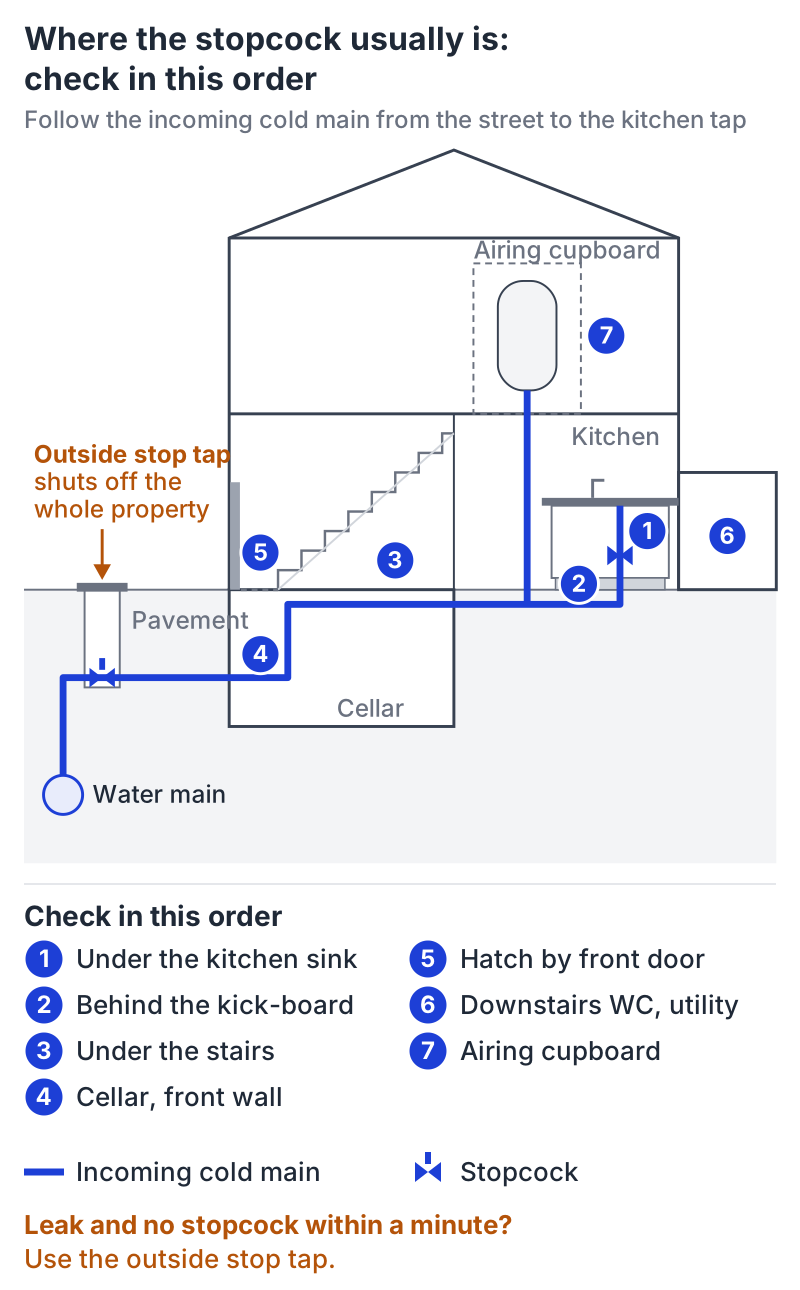
Your stopcock is usually under the kitchen sink, on the cold pipe that comes up through the floor. If it is not there, check under the stairs, the cellar, a downstairs toilet, the airing cupboard and beneath floorboards by the front door. Flats often have it in a hallway cupboard or behind the bath panel.
Water pouring out now? Do this first
If you are reading this during a leak, do not spend ten minutes searching. Start at the kitchen sink, and if it is not there within a minute, go outside to the stop tap in the pavement or front garden, which shuts off the whole property. The pavement cover is often marked with a W or the word water. A long stop tap key makes it far easier; some chambers are shallow enough to reach by hand, many are not. Our guide to the external stopcock explains how to turn it without damage.
Once the water is off, open the hot and cold taps in the bath and kitchen and flush the toilets. That drains the pipes and any loft tank faster and reduces what escapes. If water is near sockets or light fittings, switch the power off at the consumer unit, but only if the consumer unit and the floor in front of it are dry. If the consumer unit is wet, do not touch it; stay out of the area and get an electrician. For the next steps after that, see what to do when a pipe bursts.
If water is coming through a ceiling light, do not touch the switch. Turn the power off at the consumer unit if it is dry, and keep people out of that room.
The search order for a house
The stopcock should be on the incoming cold main, close to where that pipe comes into the building. Most houses follow one of a handful of patterns, so check these places in this order.
- Under the kitchen sink, usually at the back or to one side, low down where the pipe rises through the floor. Move the bleach and bin bags; it is often behind them.
- Behind the kick-board under kitchen units, when the pipe rises inside a cabinet run rather than under the sink. The plinth usually clips off.
- Under the stairs, particularly in terraced and semi-detached houses where the pipe enters beneath the hall.
- In the cellar or basement, which is where many Victorian and Edwardian London houses bring the main in, often on the front wall.
- Under a floorboard or small hatch just inside the front door, sometimes with a hinged trap or a loose board.
- In a downstairs toilet, utility room or attached garage.
- In the airing cupboard, particularly where there is a hot water cylinder and the incoming main runs straight up to it.
Follow the pipe instead of guessing
If none of those turn it up, stop looking for the valve and look for the pipe. The incoming main is the cold pipe that comes up from below the floor, or in through an outside wall, and runs to the kitchen cold tap first. In older homes it may be dull grey lead with swollen joints; in newer or re-piped homes it is usually blue plastic (MDPE) coming up through the floor and changing to copper just above.
If you can’t find the stopcock under the sink, find the kitchen cold tap supply there and trace it backwards, away from the tap. Wherever that pipe disappears into a wall, a floor or boxing, the stopcock is usually close to the point where it emerged. A pipe that runs along a skirting board towards the front of the house is heading to where the main comes in, because supply pipes normally run straight from the pavement.
The pipe will be cold to the touch on a warm day when a tap is running, because it is carrying water straight from underground. That is a good way to tell it apart from a heating pipe in the same cupboard. If you are unsure what the valve should look like when you find it, see what a stopcock looks like.
Flats and conversions: where it hides
In a flat, the stopcock can be almost anywhere along the pipe that feeds your flat from the building’s riser or from the street. Common places are a hallway or meter cupboard inside the front door, the kitchen, the airing cupboard, behind the bath panel, or in the bathroom next to the toilet. In a converted house the flat’s supply may branch off in the ground-floor hallway or cellar, which can mean your valve is in a communal area or even inside another flat.
Purpose-built blocks sometimes have the valve in a locked riser cupboard on the landing, shared with the neighbours’ valves. If there is one valve per flat in a shared cupboard, label yours once you have tested it. Your managing agent or freeholder should be able to tell you where it is; ask before you need it. The full detail is in our guide to the stopcock in a flat.
What if your home has no stopcock at all?
Almost every home has one. The Water Supply (Water Fittings) Regulations 1999 require every supply pipe feeding separate premises to be fitted with a stopvalve that is conveniently located so the supply to those premises can be shut off, and where one pipe serves several flats, each occupier must have access to a stopvalve on it. A valve buried under a kitchen that has since been tiled over, or boxed in behind a new bathroom, does not meet that in any practical sense.
It is common after a kitchen refit. Fitters lift the old units, cut the pipe short, and the stopcock ends up behind a panel or under the new floor. If you find the pipe and it vanishes into a floor with no valve visible, the stopcock is probably underneath. Do not cut into anything to reach it.
The fix is to have a new stopcock fitted where you can reach it, usually just above the floor under the sink or in an accessible cupboard, with an access panel if it has to sit inside boxing. The outside stop tap is used to isolate the supply while the work is done. See stopcock repair if you need one fitted or moved.
The £60 call-out covers the visit at any hour. If the stopcock needs replacing or moving, the repair price is agreed with you on site before any work starts.
Once you have found it: test it
A stopcock you have never turned may not work. Turn on the kitchen cold tap, then turn the stopcock clockwise until it stops. The tap should slow and stop, though water left in the pipes can keep it dribbling for a few minutes. Then open the stopcock fully anticlockwise and back it off a quarter turn. The full method, and what to do if the water keeps running, is in how to turn off a stopcock.
If the handle is stuck fast, do not lean on it with a wrench. Old stopcocks on lead pipe can shear. Try the gentle methods in our guide to a stopcock that won’t turn, and if it still will not move, get it replaced before it is needed in an emergency.
Finally, tell everyone in the house where it is, including anyone who looks after the property while you are away. A label on the valve and a photo on your phone take a minute and save a ceiling.
Questions people ask
Where is the stopcock in a new-build house?
Usually under the kitchen sink, where the blue plastic supply pipe comes up through the floor, or in a utility room or downstairs toilet. Some new-builds have it in a cupboard under the stairs next to the meter. Check the home user guide or ask the developer if it is not visible.
Is the stopcock always near the water meter?
Only if the meter is inside. Most meters are outside in the pavement or front garden, next to the outside stop tap rather than your indoor stopcock. An indoor meter is normally fitted on the incoming main just after the stopcock, so if you find one you have usually found the other.
Can I use the stop tap in the pavement instead?
In an emergency, yes. It shuts off everything, and it is often the fastest option when the inside valve cannot be found. It usually belongs to the water company and older ones can be fragile, so turn it gently and use your inside stopcock for routine jobs.
Who is responsible for fitting a stopcock if there isn’t one?
The homeowner, or the landlord in a rented home. The inside stopcock is part of your plumbing, not the water company’s. A tenant who cannot find one should ask the landlord to confirm where it is.