Hot water problems
Heating On but No Hot Water: Combi Boiler Causes
Published
When a combi heats the radiators but not the taps, the burner, gas supply and pump are working. The fault sits in the hot water side: a flow sensor that does not notice the tap opening, a diverter valve stuck on heating, or a plate heat exchanger choked with limescale. A two-minute tap test usually tells you which.
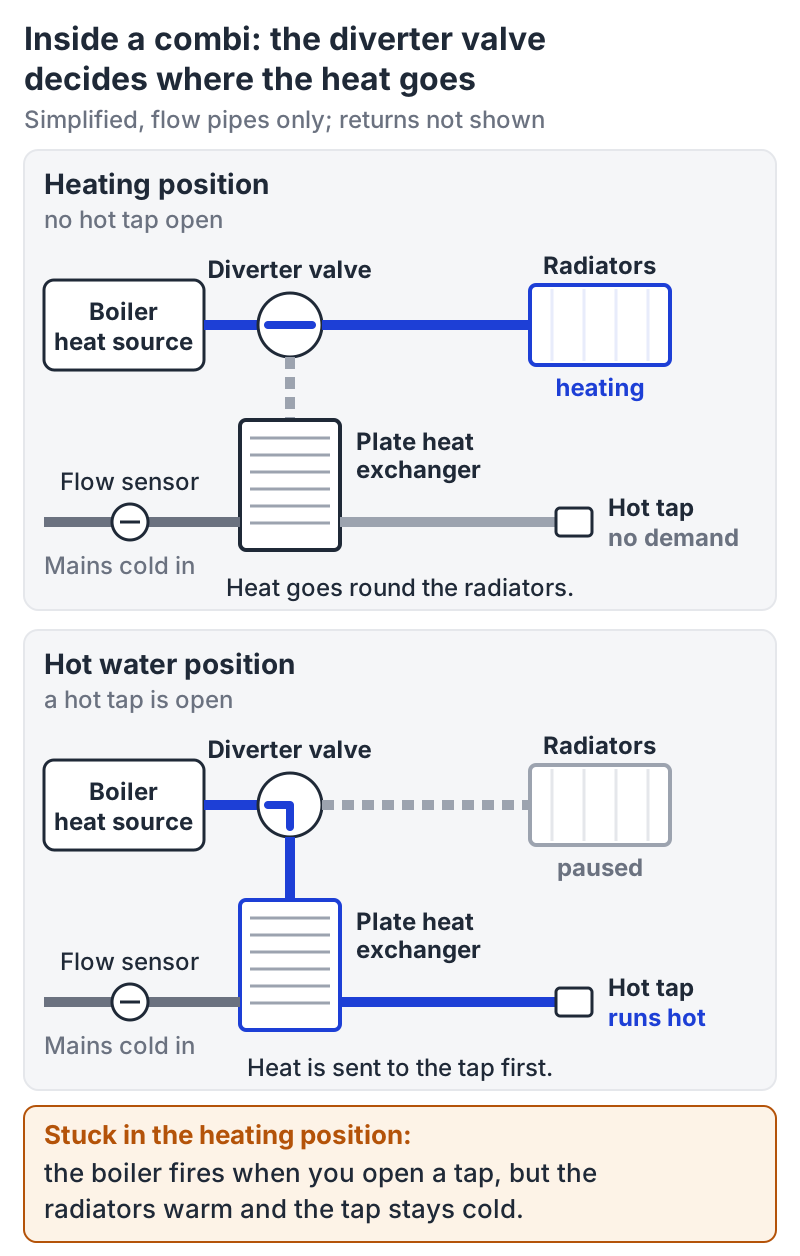
Why does a working boiler give no hot water?
A combi is built to put hot water first. The moment a hot tap opens, it is meant to stop heating the radiators, swing its internal valve over to the hot water side and fire for the tap. So when the heating carries on happily but the tap stays cold, the boiler is not broken in the big sense. It simply never makes that switch, or makes it and cannot pass the heat to the water.
That narrows things down a lot. You can rule out the gas meter, the power supply, a frozen condensate pipe and low system pressure, because each of those would stop the heating too; they belong to the wider list of reasons a boiler stops heating water. What is left is a short list of parts that only work when a tap is open, and the way the boiler behaves during a tap test points to the right one.
The two-minute tap test
Turn the room thermostat right down so the heating is not calling, and wait a minute for the boiler to settle. Then open the kitchen hot tap fully. Use a plain tap, not a mixer shower or a thermostatic bath filler, because those can mask what the boiler is doing. Stand by the boiler and watch the display and the radiators for two minutes.
- Nothing happens at all: no tap symbol on the display, no fan, no burner. The boiler has not noticed the tap. Suspect the hot water flow sensor or a blocked filter on the cold inlet.
- The boiler fires, but the radiators start getting warm instead of the tap. The diverter valve is stuck in the heating position.
- The boiler fires, the radiators stay cold, but the tap only turns lukewarm. Suspect a scaled plate heat exchanger or a diverter valve that only moves part of the way.
- The tap goes hot for a minute, then cold, and the boiler cycles on and off. Suspect the plate heat exchanger overheating, or a hot water temperature sensor.
Only watch and listen. Do not take the boiler casing off to look at anything; every part named here sits inside it and is gas appliance work.
Quick checks before you book anyone
A few non-faults look exactly like a breakdown, so rule them out first. Check the hot water dial or menu has not been turned right down, and that hot water has not been switched off on the boiler or on a smart control after a holiday or summer setting. If only one tap or the shower is cold, the boiler is fine and the fault is in that outlet: see no hot water to the shower only.
Run the kitchen cold tap. A combi needs a decent mains flow to trigger its flow sensor, so if the cold is weak too, the problem is the supply and not the boiler. A partly closed stopcock after recent work is a common reason. Finally, if the display shows a fault code, press reset once. If the code returns, write it down and stop there.
If the water comes out hot but only for a short time, that pattern has its own causes, set out in hot water that runs cold after a minute.
The three parts behind most cases
The flow sensor is a small turbine or sensor on the cold water inlet that tells the boiler water is moving. When it sticks, often with debris or scale, the boiler never gets the signal and does nothing when you open the tap. On some boilers there is a small filter just before it that can block and cause the same symptom.
The diverter valve is the switch between heating and hot water. It is a motorised or water-pressure-operated valve with a cartridge or diaphragm inside. When the motor fails or the spindle seizes in the heating position, the boiler fires for the tap but sends the heat round the radiators. That is the classic reason for heating on and no hot water, and on a Worcester combi with cold taps sometimes only the diverter motor head needs replacing.
The plate heat exchanger is a stack of thin plates where the heat from the boiler passes to the mains water. London water is hard, so limescale builds up on the water side of those plates. The first sign is lukewarm water or water that surges hot and cold; left long enough, very little heat gets through at all. A scale reducer on the cold feed slows this down but does not stop it entirely. More on this in lukewarm hot water from a combi.
What the engineer does, and what it tends to cost
An engineer repeats your tap test with the boiler in its service or diagnostic mode, which on a Vaillant means reading the S.10 and S.14 status codes, and which shows whether the flow sensor is registering and which way the diverter is driving. They will check the cold inlet filter, measure the hot water temperature at the tap against the flow rate, and look at the temperature difference across the plate heat exchanger. The fault is usually confirmed in one visit.
Typical market ranges for the repair itself, parts and fitting, are roughly £150 to £300 for a flow sensor, £200 to £450 for a diverter valve or cartridge, and £300 to £700 for a plate heat exchanger, depending on the boiler make and how easy the part is to reach. Some boilers can have the plate heat exchanger descaled instead of replaced, which costs less when the plates are not damaged.
With us you pay the £60 call-out at any hour, and the repair price is agreed with you on site before any work starts. Gas work is carried out by Gas Safe registered engineers. How the call-out works is set out on the pricing page, and the visit itself is described on our no hot water repair page.
Can it wait until the morning?
Usually yes, as long as the heating works and nobody in the house depends on hot water for care or hygiene. You can boil kettles for washing and, if you have one, use an electric shower. It becomes more urgent with a baby, an elderly or unwell person, or a rented home where the landlord has repair duties; tenants can read your rights when there is no hot water.
Treat it as an emergency straight away if the boiler is also leaking, making a loud banging, or if you smell gas. For gas, open windows, turn the meter valve off if it is safe to reach, use no switches, then leave the property and call the National Gas Emergency Service on 0800 111 999. Do not call a plumber first.
Questions people ask
Why does my combi heat the radiators when I run the hot tap?
Almost always because the diverter valve has stuck in the heating position. The boiler fires for your tap, but the heat goes round the radiators instead of into the hot water. The valve motor or cartridge needs replacing, which is an engineer job inside the casing.
Can I fix a stuck diverter valve myself?
No. The valve is inside the sealed boiler casing and replacing it means draining the boiler and working next to gas components. Your safe checks are the settings, the cold supply, and a single reset.
Is it safe to keep using the heating with no hot water?
Yes, if there is no leak, no fault code that keeps returning and no smell of gas. The heating side is working normally. Book a repair, but there is no reason to switch the boiler off in the meantime.
Would a new boiler be cheaper than fixing the hot water?
Rarely for a single part. A flow sensor or diverter valve costs a fraction of a replacement. It only becomes worth weighing up on an old boiler that has already had several major parts, or where parts are no longer made.