Toilets, taps & fixtures
Sewage Smell in the Bathroom or House: Find the Source in 5 Checks
Published
A sewage smell in the bathroom or house means drain air is getting past a barrier that should stop it. Check five things in order: a dried or siphoned trap, the toilet’s seals, the soil stack vent or its valve, a cracked pipe, then the drain outside. The first two cause most smells and take minutes to test.
Is it sewage, or could it be gas?
Rule this out before anything else. Mains gas is given a smell that many people describe as rotten eggs, and sewer air carries hydrogen sulphide, which smells of rotten eggs too. The two are easy to confuse at night with a window shut.
If the smell is near the boiler, the cooker, the gas meter or any gas pipe, or you simply are not sure, treat it as gas. Open the windows, turn off the gas at the meter if you can reach it safely, do not use switches, then leave the property and call the National Gas Emergency Service on 0800 111 999. The full steps are in what to do if you smell gas.
A drain smell behaves differently. It is strongest at a plughole, around the toilet or inside a boxed-in pipe, it comes and goes with water use, and it is usually worse in the morning or after a fitting has been left unused. If that fits, work through the checks below in order. They run from the quickest and most likely to the slowest and least likely.
Check 1: a trap that has dried out or been sucked empty
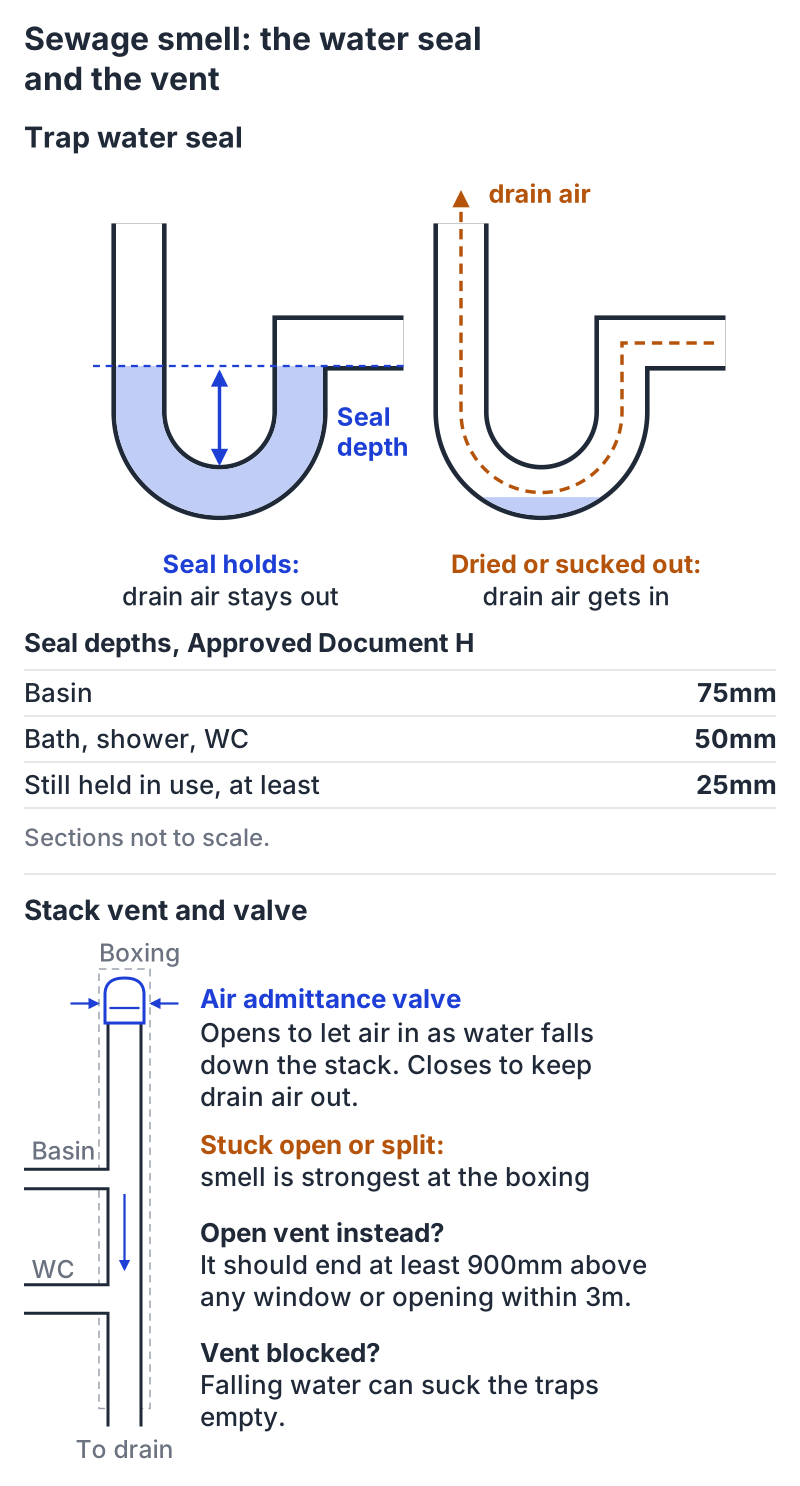
Every basin, bath, shower, bidet and toilet has a trap: a bend that holds water so air from the drain cannot rise into the room. Building Regulations Approved Document H sets the seal depth at 75mm for a basin and 50mm for a bath, shower or WC, and says a trap should still hold at least 25mm of water under working conditions. Lose that last inch and the room smells of the sewer.
Go round every fitting in the smelly room, and the rooms either side, and run each one for a minute. That includes the ones nobody uses: the guest basin, the bath that only gets showers, the bidet, a floor gully in a wet room, a utility sink. A trap left for a few weeks, especially in a warm room or with the heating on, can simply evaporate dry. If the smell fades within an hour of running everything, you have found it.
If a trap keeps emptying even though the fitting is used, it is being siphoned. Listen for gurgling from a basin or bath when the toilet is flushed or another fitting drains, and shine a torch down the plughole afterwards to see whether the water level has dropped. A trap that loses its water that way needs a pipework fix, which is Check 3.
Pour water into a floor gully or an unused shower before you go away. Returning to a sewage smell after a holiday is almost always a dry trap.
Check 2: the toilet’s seals at the back and at the floor
The toilet is the biggest trap in the house and the most common source once dry traps are ruled out. There are three places it can let drain air out.
- The water in the pan. Look at it an hour after flushing. If it sits noticeably lower than usual, it is being siphoned or a crack is draining it, and the pan is open to the soil pipe.
- The pan connector, the rubber or plastic sleeve joining the back of the pan to the soil pipe. If the toilet rocks, has been knocked, or the connector has hardened, it pulls away and the gap breathes sewer air straight into the room. Put your nose near the back of the pan: a connector fault smells strongest there and is worse just after a flush. See a leaking toilet pan connector for what the joint looks like.
- The base of the pan. A bead of silicone round the foot hides spills that have soaked into the floor, and on a floor that was wetted by a connector leak the smell can come from the boards rather than the pipe. Dark or soft flooring at the back of the pan is the sign.
A connector that leaks dirty water when flushed is a hygiene problem and can soak a ceiling below. Stop using that toilet until it is fixed.
Check 3: a soil pipe smell from the vent or the valve in the boxing
Your soil stack is the large pipe, usually 100mm or 110mm, that takes the toilet waste down to the drain. Its top is either open to the air above the roof line or, where it ends inside the building, capped with an air admittance valve. The valve lets air in when water rushes down the stack, which protects your trap seals, and it should close to keep sewer air out.
Look inside the bathroom boxing, the airing cupboard or the loft for a grey, white or black cap on top of a vertical pipe. If the smell is strongest there, or inside that cupboard, the valve’s membrane may be stuck open or split. Approved Document H says these valves should be accessible for maintenance, so there should be an access panel. A replacement 110mm valve typically costs £20 to £40 at a builders’ merchant. A push-fit valve pulls off and a new one pushes on; one that was solvent-welded in place has to be cut off and the new one glued on.
Outside, look up at the stack. A vent pipe that ends close to a window or a roof light can blow sewer air straight back in; the guidance is that an open vent should finish at least 900mm above any opening into the building within 3m. A vent blocked by a nest, leaves or a missing cage causes the opposite problem: water rushing down the stack pulls the traps empty, which brings you back to Check 1.
Check 4: a cracked pipe or a failed joint
If every trap holds, the toilet is sealed and the vent is clear, the smell is escaping from the pipework itself. Suspects are old cast iron stacks with hairline cracks, push-fit joints that have slipped, solvent joints that were never properly made, and waste pipes damaged when a kitchen or bathroom was refitted.
The clue is a smell that stays in one spot, usually behind boxing, under a bath panel or in a ceiling void, whether or not water is running. Stains, a soft patch of plaster, or flies in a room where there is no food are also signs. A joint that drips only while a fitting drains is covered in a leaking waste pipe.
Finding this kind of fault is a job for a plumber. Approved Document H allows smoke testing to find defects in the pipework inside a building where a water test has failed: the engineer blows harmless smoke into the system and watches where it comes out. On plastic pipes they will usually work by air testing, removing boxing and inspecting joints instead, since the same guidance does not recommend smoke testing for PVC-U.
Check 5: a drain smell in the house, or a sewer smell outside
When the whole house smells, not just the bathroom, go back over two earlier checks first: run the traps in every room nobody uses, including a spare bathroom, a utility sink and any floor gully, and look up at the soil stack outside for a vent that ends near a window.
A smell in several rooms at once, a smell outside the back door, toilets that are slow to clear, or gurgling from every fitting points past the house to the drain. Find the inspection chamber, the manhole cover in the garden, drive or basement. Covers are heavy and can drop: lever it up with two large screwdrivers, one in each slot, keep fingers out from underneath, never lean into the chamber, and put it straight back afterwards so nobody falls in.
Clear water running along the channel is normal. A chamber filling with standing waste means a blockage downstream. If your chamber is clear but the next one along, or the street, is backing up, the blockage may be in a shared or public sewer, which is the water company’s job to clear rather than yours. Blocked drains and who deals with them explains how to tell.
Also check any outside gully under a waste pipe. A gully whose grid is clogged with leaves, or whose own water seal has dried in a warm spell, smells through the ground-floor rooms and is easily mistaken for an indoor fault.
Why does the smell come and go, or get worse in hot weather?
A smell that vanishes for days and then returns, or turns up every summer, usually depends on heat or on how much water goes down the pipes. Four causes explain most of these.
The first is evaporation. A trap only holds 50mm to 75mm of water to begin with, and in a heatwave, or in a bathroom beside a radiator or a hot water cylinder, a fitting that is rarely used can lose its seal in days rather than weeks. The second is low flow. Over a holiday, or when a spare bathroom sits empty, traps are not topped up and waste lies longer in the pipes, so the smell greets you on return and fades after a day of normal use.
The third is the drain itself warming up. Bacteria break waste down faster in warm weather and give off more of the rotten-egg gas, so a drain that never quite clears, with a fat build-up or a dip where waste settles, is the one you notice in July. The fourth is a vent that only fails some of the time: an air admittance valve whose membrane sticks now and then, or an open vent that blows back through a window only in certain winds.
The checks are simple. Run every unused basin, bath, shower and floor gully for a minute, and do it weekly through a hot spell or before you go away. Open the boxing round the valve, sniff it while someone flushes, and replace it if the smell is strongest there.
If the traps are full and the valve is new but the smell keeps returning to one spot, suspect a cracked pipe or a joint that opens as it warms, which is Check 4. If it is worse outside, drains are slow or the smell follows heavy use, ask for a CCTV drain survey. A camera shows cracks, root entry and dips that no smell test can locate.
What is urgent tonight, and who to call
A sewage smell on its own is unpleasant rather than an emergency. Run the traps, close the toilet lid, keep the door shut and a window open, and it can wait for daylight. Some signs cannot wait.
- Sewage coming back up into the bath, shower or toilet: stop using every fitting in the house, because the water has nowhere to go.
- Dirty water dripping through a ceiling below a bathroom: turn off the water to that toilet and keep people out of the room below. See a ceiling leak below a bathroom.
- A smell that could be gas, or anyone with headaches, dizziness or nausea near the boiler: open windows, turn the gas off if safe, get outside, call 0800 111 999, then seek medical advice.
For a toilet seal, a stuck valve or a leaking waste joint, our toilet repair service covers the visit at any hour. The £60 call-out applies day or night, and the repair price is agreed with you on site before any work starts, as set out on our page about emergency plumbing costs.
Questions people ask
Why does my bathroom smell of sewage only in the morning?
Overnight nothing runs through the traps, so a slow siphon or evaporation leaves the seal low by morning, and a closed door lets the smell build. Once the fittings are used the seals refill. Check each trap’s water level first thing with a torch.
Why does my house smell of drains?
Drain air is getting past a trap, a seal or a vent. Run every unused fitting first, since a dry trap is the usual cause, then check the toilet’s pan connector and the valve on the soil pipe. A smell in several rooms at once points to the drain outside (Check 5).
Is a sewage smell in the house dangerous?
At the levels you smell from a dry trap or a loose connector it is unpleasant rather than harmful, but it means drain air is getting in and should be fixed. If you cannot tell it apart from gas, treat it as gas: ventilate, shut the meter valve if safe, get out and call 0800 111 999.
Why does the house smell of sewage when it rains?
Heavy rain can fill a combined drain or sewer so that air is pushed back up the pipes, and a trap with a weak seal lets it through. A strong smell with slow drains in wet weather is worth reporting to the water company.
Can I just pour bleach down to stop the smell?
It masks the smell for a few hours but fixes none of the five causes. Running water into dry traps, reseating the toilet or replacing a stuck valve does. Never mix bleach with other drain products.