Leaks & burst pipes
Underground Water Leak: What You Can Do Yourself
Published
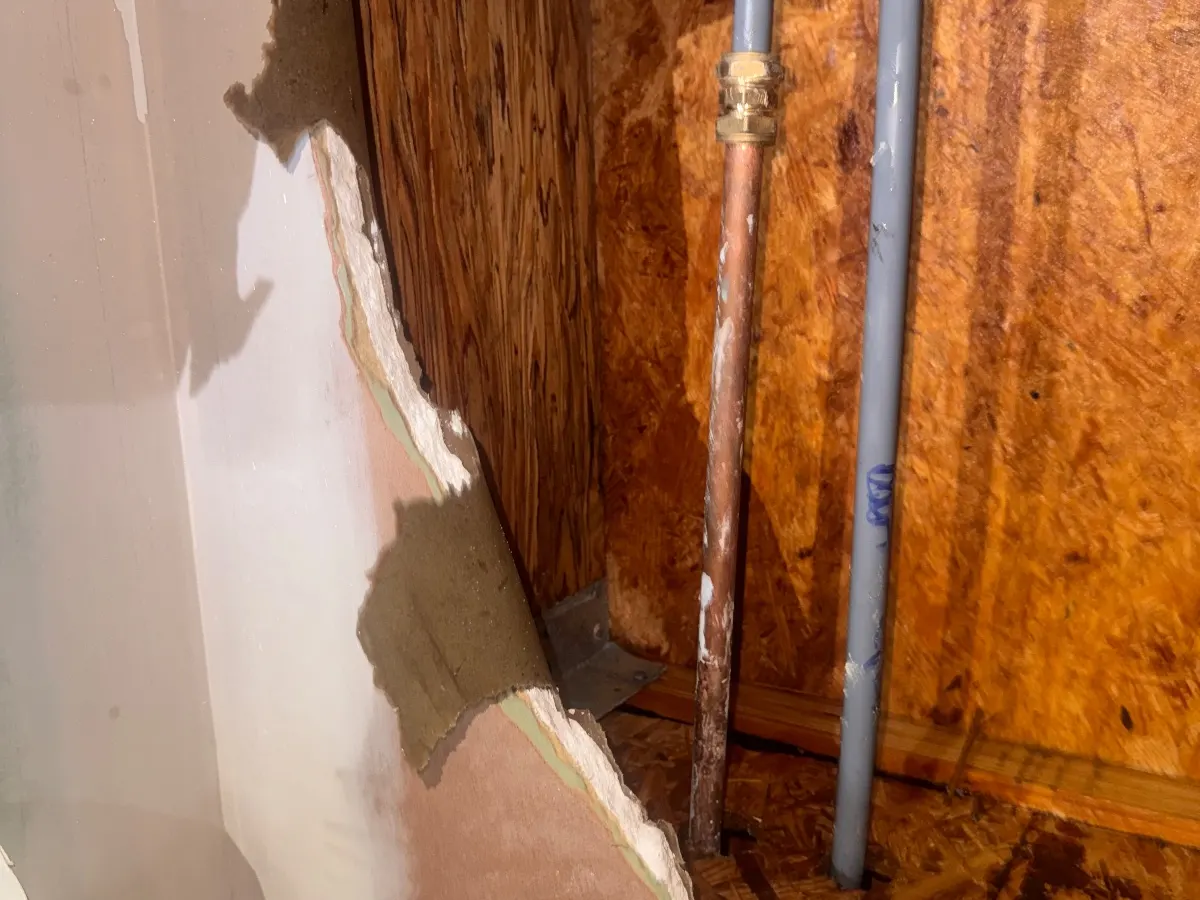
Turn off every tap, shut your indoor stopcock and watch the water meter. If it still turns, water is escaping between the meter and the house, which almost always means the buried supply pipe. Signs above ground back it up: a patch of garden that never dries, sinking paving, water in the meter chamber or falling pressure at the taps.
The home test that settles it
An underground leak is hard to see and easy to prove. You need a meter reading, access to your indoor stopcock and about an hour. If you do not have a meter, skip to the listening test further down.
- Make sure nothing is using water: taps, toilets, washing machine, dishwasher, softener, and a loft tank that may still be refilling.
- Close the indoor stopcock fully. It is usually under the kitchen sink, where the supply pipe comes up through the floor.
- Open the meter chamber lid outside and take a full reading, including the red digits. Photograph it.
- Wait an hour without opening the stopcock, then read it again.
- Any movement at all, or a flow indicator that is still spinning, means water is leaving the pipe between the meter and your stopcock.
If the meter stops when the stopcock is closed but moves when it is open, the leak is indoors, not underground. Signs of a hidden water leak covers that search.
Signs above ground that point to a buried leak
Once the meter test says there is a leak, the surface usually shows you roughly where. Walk the likely route of the pipe. In most London houses the supply runs in a fairly straight line from the boundary stop tap in the pavement or front garden to the point where it enters the house, often the kitchen or the front of the hall.
- A strip or patch of lawn that is greener, soggier or sunk compared with the rest, especially in a dry spell.
- Paving slabs or a driveway that have dropped, rocked or cracked along one line.
- Water sitting in the meter or stop tap chamber when it has not rained.
- Damp at the base of the front wall or in a cellar or under-stairs cupboard where the pipe comes in.
- Water pressure at the kitchen tap that has slowly got weaker.
- Moss or algae in one spot on a path that is otherwise dry.
No meter? Listen for it and rule out the drains
Without a meter, turn everything off and put the tip of a long screwdriver against the stopcock or the pipe just above it, with the handle pressed to your ear. A steady hiss or rush with everything off is water moving through the pipe. It works best late at night when the street is quiet. Hearing it with the stopcock closed tells you the leak is upstream, on the buried section.
Wet ground is not always a supply pipe. Rainwater, a cracked drain and groundwater all make soggy patches. One useful check: mains water in the UK carries a small amount of chlorine, and rainwater and groundwater do not. A cheap chlorine test strip, the kind sold for pools and aquariums, dipped in water pooling in a hole or chamber can hint at mains water. A positive result is a strong clue; a negative one does not rule a mains leak out, because chlorine fades in soil.
If the water smells of sewage or appears when you flush or run a bath, it is almost certainly a drain, and the fix is different.
Whose pipe is leaking?
Your water company, Thames Water across most of London, owns the main in the street and the communication pipe up to your boundary stop tap. From the boundary stop tap to your house is the supply pipe, and in most cases that belongs to the property owner. So a leak you have proved with the stopcock closed is usually yours to repair. Mains water pipe responsibility explains the edge cases, including shared supplies in terraces and blocks of flats.
If water is coming up in the pavement or the road, or the leak is at the meter chamber itself, report it to the water company first. They will usually visit to check which side of the stop tap it is on, and that visit costs you nothing. Water company leak or plumber? sets out which to call for what. If you are on a meter, ask about a leak allowance for the water already lost before you book a repair, and keep the meter photos.
Do not dig near the boundary stop tap or across a footpath. Gas, electric and telecom cables share the same strip of ground, often at a similar depth.
What you can safely do tonight
A small leak can wait for a daytime repair. Keep the boundary stop tap turned off overnight and while you are out, and open it only when you need water, so the buried pipe is only under pressure for part of the day. That slows the leak and the damage to foundations and paving.
A large leak cannot wait: water bubbling up through the ground, the meter racing, a sudden loss of pressure indoors, or water getting into a cellar or under a floor. Close the boundary stop tap (it takes a long-handled stop tap key, sold cheaply at plumbers’ merchants), and warn any neighbours on a shared supply first. The indoor stopcock will not stop a leak on the buried pipe, so if you can’t reach the outside tap, call the water company. Our leak repairs visit starts with the £60 call-out at any hour, and the repair price is agreed with you on site before any work starts.
How an underground leak is found and fixed
An engineer starts by repeating your meter and stopcock tests to confirm the leak is on the buried section. On a short run, the surface signs often put the leak within a metre or two, and a small excavation finds it. On a longer run, under a driveway, or where the ground shows nothing, a leak detection survey with acoustic listening equipment or tracer gas pinpoints it before anyone digs.
The repair then depends on the pipe. A modern blue plastic (MDPE) pipe with a single failed joint can be cut and rejoined with a compression coupler. An old lead or galvanised iron pipe that has split once will usually split again, and replacing the whole supply pipe is the better value. New pipes can often be pulled or thrust-bored (moled) under a garden without trenching the whole length.
Published UK cost guides give these typical market ranges, which are not our prices. A leak detection survey on a buried pipe usually costs about £150 to £650, depending on whether acoustic listening finds it or tracer gas is needed. Repairing a single leak that is found quickly and easy to reach commonly runs to £300 to £800, and a longer or deeper run, or a leak under a hard surface, often £800 to £1,800 or more. A full new supply pipe costs roughly £1,200 to £4,400 depending on length, depth and what has to be lifted and relaid, with a moled run of 8 to 15 metres across a garden at the lower end, about £1,200 to £3,000. Check your buildings insurance too: many policies include trace and access cover for finding underground leaks, but not the pipe repair itself.
Questions people ask
How do I know if a leak is underground or inside the house?
Close the indoor stopcock with everything off and watch the meter. If it keeps moving, the leak is on the buried pipe before the stopcock. If it stops, the leak is inside.
Can an underground water leak cause subsidence?
A long-running leak can wash out or soften the soil under paths and, in the worst cases, foundations, particularly on clay. That is why a proven leak should be fixed promptly rather than left.
Will Thames Water fix a leak on my supply pipe?
Their responsibility ends at the boundary stop tap, and Thames Water says the supply pipe from your boundary to the house is the homeowner’s. They will check which side a leak is on once you report it through their leak line, but the supply pipe on your side is normally yours to repair. Ask them about any current help or leak allowance before booking.
Can I find an underground leak myself without digging?
You can prove it and narrow it down with the meter, the stopcock and the surface signs. Pinpointing an exact spot on a long or hidden run usually needs listening or tracer gas equipment.