Water supply problems
Who Owns the Water Pipe to Your House?
Published

The water company owns the main and the short communication pipe up to your outside stop valve, usually at the property boundary. From that valve to your inside stopcock is the supply pipe, which belongs to the property owner, as does every pipe indoors. Shared supply pipes belong jointly to every home they feed.
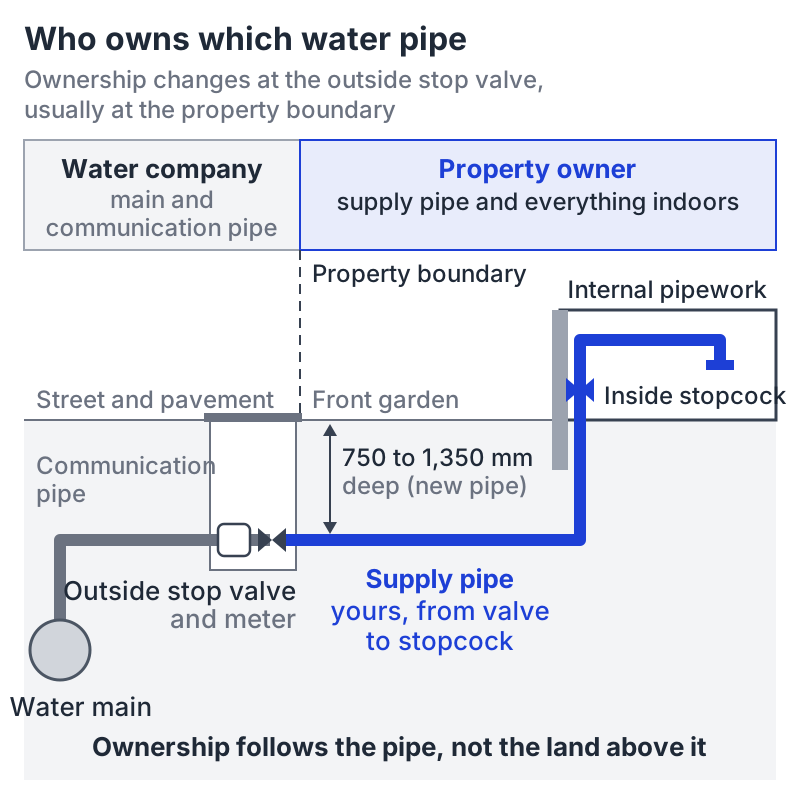
The two pipes, and where ownership changes
Between the main in the street and your kitchen tap there are really only two pipes that matter for ownership. Thames Water describes them this way: it owns the communication pipe, which links its main to your supply pipe, and its responsibility ends at your property boundary, which is usually where the outside stop valve sits. You own the supply pipe, which starts at that outside stop valve and ends at your inside stop valve, and you own all the internal pipework after it.
Other water companies use the same split, because it comes from how the water industry defines a service pipe. So the question “whose pipe is it?” nearly always becomes “which side of the outside stop valve is it on?”.
The water meter, if you have one in the pavement, is the water company’s. The ground over the supply pipe may be a public pavement, a shared path or your front garden, but the pipe underneath is still yours. Ownership follows the pipe, not the land it runs through.
How to work out where your line is
Start by finding the outside stop valve. It sits under a small metal or plastic cover, roughly the size of a hand, in the pavement outside or just inside your front boundary. It is often marked with a W, or it is the cover beside a meter lid. Everything on the street side of that cover is theirs.
If you cannot find one, you are not alone. In older London terraces the valve is often buried under paving, tarmac or a front wall, or it was never fitted where you would expect. Without a visible valve, the working assumption is that ownership changes at your property boundary.
When you bought the house, your solicitor probably ordered a drainage and water search, often called a CON29DW. It confirms whether the property is connected to the public water supply and usually includes a plan of nearby mains and sewers. It will not show your private supply pipe, but it tells you where the main is. Beyond that, ask the water company. They can tell you what their records show and will send someone out if there is a leak to assess.
Only use the outside stop valve in an emergency, and only with a proper stop tap key. Forcing an old one can break it, and a broken valve on the boundary means a dig.
Shared supply pipes in older terraces
Many Victorian and Edwardian houses were built with one supply pipe feeding a whole row. It may run from a single outside valve along the back of the gardens or under the front paths, with a branch into each house. There is often no way to tell from inside the house.
Thames Water’s position is that shared supply pipes are the joint responsibility of every owner they serve, and each owner is responsible for the branch that feeds only their home. In practice that means a leak on the shared section needs the neighbours to agree who pays and who organises the work. The water company does not arbitrate between neighbours.
Clues that you are on a shared supply: your water pressure drops when next door runs a bath, there is no outside stop valve outside your house but there is one outside a neighbour’s, or turning off one outside valve cuts off several houses. If you suspect a shared supply, find out before anything goes wrong. Separating it onto its own new pipe is sometimes worth it, especially when replacing lead, although it is private work arranged and paid for by the owners.
Lead supply pipes and the free replacement offer
If your home was built before 1970, the supply pipe may be lead. Lead pipe is dull grey, soft enough to scratch with a key, and has bulbous wiped joints rather than neat fittings. You will usually see it where the pipe comes up through the floor to the stopcock. Our guide to lead water pipe problems covers the health and pressure issues it causes.
Replacing a lead supply pipe is the owner’s cost, but Thames Water will replace its own communication pipe free of charge when you replace your lead supply pipe, provided you meet its conditions. At the time of writing these include a pre-1970 property with suspected lead pipework, locating the outside stop valve, and doing the work within three months of applying. The new pipe has to meet the water regulations, including being laid between 750mm and 1,350mm deep, and be signed off by an approved plumber or inspected. The scheme does not cover splitting a shared supply. Check the current terms with them before booking a contractor, as conditions change.
Flats, rented homes and new builds
In a block or a converted house, the pipe from the outside valve to the building is usually shared and falls to the freeholder or management company. The risers and common pipes are theirs too. Pipework inside your flat, from your own stopcock onwards, is normally the leaseholder’s. The lease sets this out, and it is the document that settles arguments. For a leak between flats, see a leak from the upstairs flat.
If you rent, the pipes are not your problem to fix. Under section 11 of the Landlord and Tenant Act 1985, landlords of most residential tenancies must keep the installations for the supply of water, and for space heating and hot water, in repair and proper working order. Tell the landlord or agent in writing as soon as you spot a leak.
On newer estates, pipes can still be with the developer until the water company formally adopts them. If you live on a recently built street and get no clear answer from the water company, ask the developer or the management company named in your purchase pack.
When something goes wrong on your side
Signs of a leak on your supply pipe are a wet patch or a persistently green strip in the front garden, a meter that keeps turning with every tap off, or pressure that has dropped for no reason while the neighbours are fine, which rules out a leak on the main in your area. Water meter running with no taps on shows how to confirm it, and underground water leak covers what happens next.
If the water has stopped altogether and the street is fine, the fault is almost certainly between the outside valve and your taps. Our no water emergency visit starts at the outside stop valve and works inwards. The £60 call-out covers the visit at any hour, and the repair price is agreed with you on site before any work starts. For a pipe that has burst and is pouring, close the stopcock first, then read a Thames Water burst pipe: whose side is it on.
Questions people ask
Is the water company responsible for the pipe under the pavement?
Usually up to the outside stop valve or your property boundary. Where the valve sits out by the kerb, the stretch between it and your wall can be treated as your supply pipe even though it runs under public land, so ask the water company what its records show before paying for a dig.
Does home insurance cover the supply pipe?
Some buildings policies cover damage to underground service pipes, and many include trace and access cover to find a hidden leak. Cover for the pipe repair itself varies, so check the wording or ask the insurer.
Who pays if a shared supply pipe leaks?
Every owner on the shared section is jointly responsible for it, and each owner pays for the branch that serves only their home. The split of costs for the shared part is for the neighbours to agree.
I rent. Do I have to pay for a leak on the supply pipe?
No. For most residential tenancies the landlord must keep the water supply installations in repair. Report it in writing and keep a copy.