Boiler & heating breakdowns
Condensate Pipe Leaking: Boiler Still Safe to Use?
Published
A leaking condensate pipe is rarely dangerous. The water is mildly acidic waste from the flue gases, not gas and not heating water, so the pressure gauge will not drop. You can usually keep the boiler running for a day with a tray under the drip, but a pipe that backs up will lock the boiler out.
How do I know the leak is the condensate pipe?
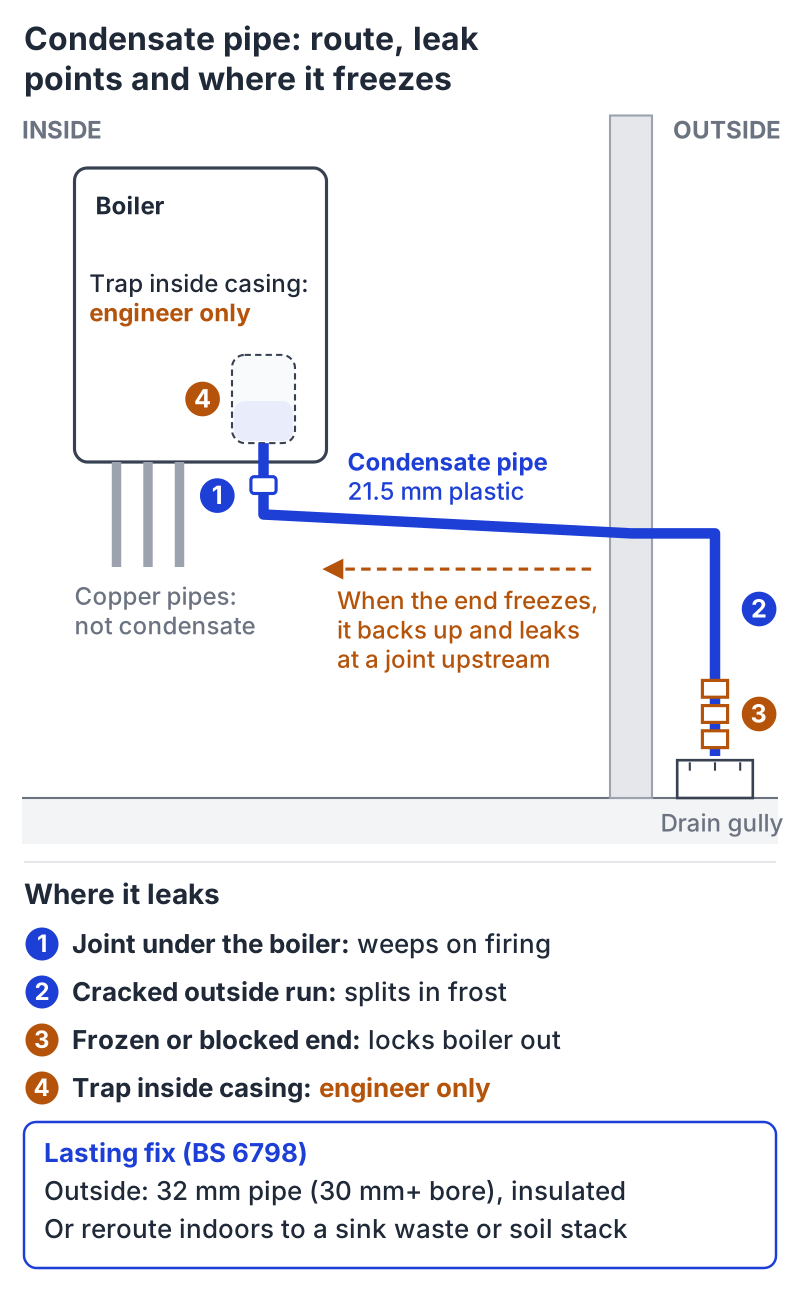
The condensate pipe is the plastic one, usually white or grey and around 21.5mm across, that leaves the bottom of the boiler and runs to a sink waste, a soil stack or a drain outside. The other pipes under the boiler are normally copper. If the drip is on the plastic pipe or the floor directly under it, you have your answer in most cases.
Two quick tests confirm it without opening anything. First, watch the pressure gauge on the front of the boiler over a few hours. Condensate is not part of the sealed heating circuit, so a genuine condensate leak leaves the gauge where it was. If the needle is falling, the water is coming from a copper pipe or a valve, and our guide to which boiler pipe is leaking will help you tell them apart.
Second, notice when it drips. A condensing boiler only makes condensate while it is burning, so the leak should come and go with the heating or a running hot tap. Water that keeps coming with the boiler switched off at the spur is not condensate.
- Plastic pipe, drip only while the boiler fires, gauge steady: condensate
- Copper pipe, gauge falling: heating circuit water, see a leak repair
- Copper pipe, gauge steady, drip carries on with the boiler off: the mains water connections
- Water from the copper pipe that goes through the wall: the pressure relief valve
Is it safe to keep using the boiler?
For most condensate leaks, yes, for now. The liquid is slightly acidic, a bit like weak vinegar, so it will mark a wooden floor or corrode a metal tray over time, but it is not a gas or a fire risk. Put an old plastic tub or a towel under the drip, keep children and pets off it, and wipe up spills with plenty of water.
There are three cases where a boiler leak becomes dangerous and you should switch the boiler off at the fused spur instead. One is water getting into the boiler casing or near the electrics below it. Another is a leak from inside the casing itself, meaning from the trap rather than the external pipe. The last is any smell of gas or fumes. The trap sits inside the boiler casing, and its water seal is also what stops flue gases escaping down the condensate pipe, so a trap that leaks or has cracked is a job for an engineer, not a tray. Work inside the casing is gas work. Gas work is carried out by Gas Safe registered engineers.
If you can smell gas, open the windows and shut the gas off at the meter if it is safe to reach, use no switches, then get outside and call the National Gas Emergency Service on 0800 111 999. Do not switch anything on or off first.
Where condensate pipes usually leak
Engineers find condensate leaks in a small number of places, and the pattern of the drip tells you which.
- The first joint below the boiler. Push-fit or solvent-welded joints just under the casing get knocked by boxes and hoovers. A joint that has been pulled slightly apart weeps every time the boiler fires.
- The connection to the sink waste. Many condensate pipes join the kitchen waste under the sink with a spigot or a push-in fitting. If that fitting has lost its seal, the leak shows up in the sink cupboard, not near the boiler.
- A blockage further along. A blocked or frozen pipe makes condensate back up and escape at the weakest joint upstream. The leak looks like a failed joint, but the cause is at the far end.
- A cracked outside run. Thin external pipe gets brittle in sunlight and splits in frost. You may only notice it as a wet patch on the wall or a lockout on the first cold morning.
- The trap inside the boiler. Heavy dripping from inside the casing, or water tracking along the underside of the case, points to the siphon or trap. This is not a householder repair.
What you can safely check yourself
Keep to the pipe outside the boiler casing. Everything behind the front panel is off limits, even if you can see the trap through a gap.
Look along the pipe with a torch and dry each joint with kitchen roll. Then run a hot tap for a few minutes so the boiler fires, and see which joint goes wet first. If a push-fit joint has visibly slipped apart, pushing it firmly home often stops the drip. Do not glue anything, and do not cut or reroute the pipe.
In freezing weather, check the outside end. If it is frozen solid, pour warm water (not boiling, which can crack the plastic) along the outside section, working back from the end. Our guide to a frozen condensate pipe and a boiler that will not fire covers the reset afterwards.
If the leak is at the sink, check the spigot where the plastic pipe enters the waste and make sure the sink trap below it is not blocked. A blocked sink stops condensate draining just as surely as a frozen pipe.
When it cannot wait until morning
A slow drip into a tray can wait for a normal-hours visit. It moves up the list when the boiler starts locking out. Many condensing boilers have a sensor or a blocked-condensate function that shuts the burner down when the trap fills, and you will see a fault code or a flashing light, often after the heating has been on for a while. That is the boiler protecting itself, and in winter it means no heating or hot water.
Call someone out that night if the leak is running onto electrics, coming from inside the casing, or has left a household with young children or elderly people without heat. Anything that affects the flue or the trap is best dealt with before the boiler is run again. If the boiler is locking out repeatedly, emergency boiler repair is the right route rather than resetting it over and over.
What the engineer does and what it typically costs
On the visit the engineer confirms the leak is condensate, then works from the boiler outwards. The trap is removed, cleaned and refitted with a new seal if it is sound, or replaced if it is cracked. The pipe is flushed through to find any blockage, and loose or failed joints are cut out and remade.
Where the external pipe is the problem, the fix is often to follow current guidance rather than just patch it. BS 6798, the installation standard for gas boilers, calls for condensate pipe run outside to be insulated and upsized to a bore of at least 30mm, which in practice means 32mm pipe, because the thin 21.5mm pipe freezes. Rerouting the pipe inside to a sink waste or soil stack, where the layout allows, removes the frost problem altogether.
As a typical market guide, remaking a joint or replacing a short section of condensate pipe is one of the cheaper boiler repairs, commonly in the region of £80 to £200 including labour. A replacement trap or siphon fitted inside the boiler sits in a similar band or a little higher depending on the make. For us, the £60 call-out covers getting an engineer to you, and the repair price is agreed with you on site before any work starts. You can see what an emergency plumber costs before you book.
If the pipe is fine and the boiler is leaking from somewhere else, the engineer moves on to the sealed system. See leaking boiler repair for what that visit involves.
Questions people ask
Can I just put a bucket under a leaking condensate pipe?
For a day or two, yes, as long as the drip is from the external pipe and not from inside the casing. Use a plastic container, not metal, because condensate is mildly acidic. It is a stopgap: a leaking joint often means a blockage further down that will eventually lock the boiler out.
Does a leaking condensate pipe make the boiler lose pressure?
No. The condensate pipe carries waste water from the flue gases and is not connected to the sealed heating system. If your pressure is dropping as well, there is a second leak on a copper pipe or valve, or the pressure relief valve is discharging.
Is condensate water harmful to touch?
It is weakly acidic, so wash it off skin and rinse any surface it has sat on. It is not toxic in small amounts, but keep pets from drinking it and do not let it pool on wooden floors or bare metal.
Why does my condensate pipe only leak in cold weather?
Because the outside end is freezing. Ice blocks the pipe, condensate backs up and escapes at the first weak joint inside. Thawing it gets you going again, but insulating or upsizing the external run, or rerouting it indoors, is the lasting fix.