Boiler & heating breakdowns
Boiler Pressure With Heating On vs Off: The Normal Range
Published
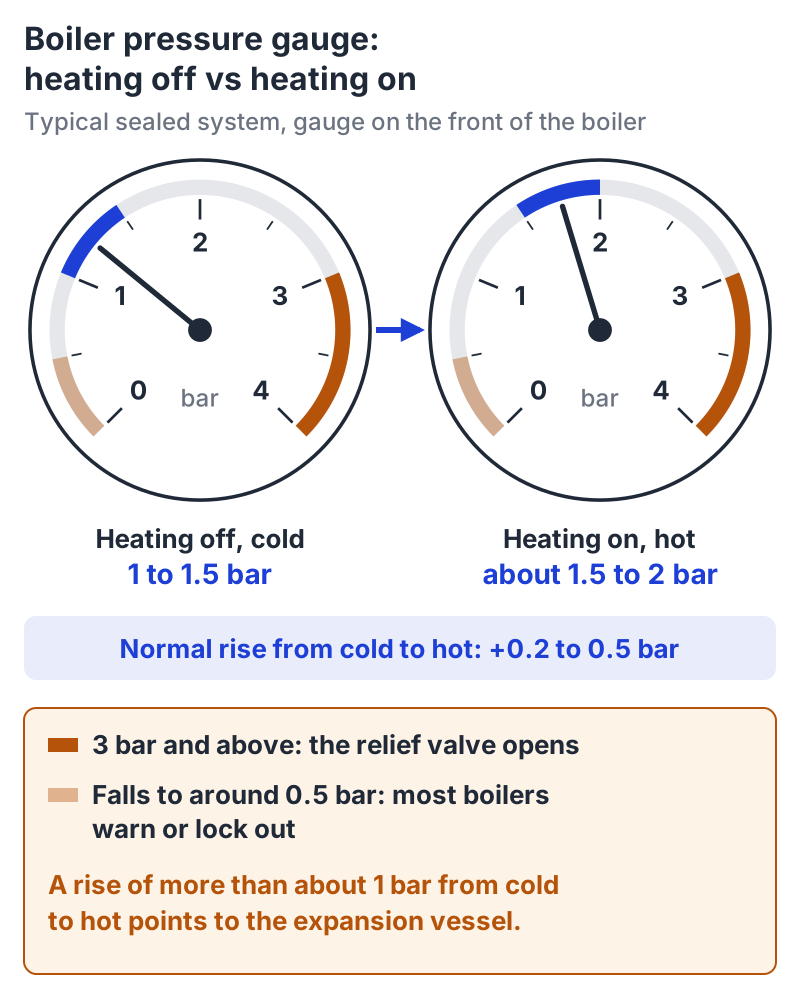
With the heating off and the water cold, boiler pressure should usually read 1 to 1.5 bar. With the heating on it will rise, typically by 0.2 to 0.5 bar, to around 1.5 to 2 bar. A cold reading under 1 bar, a hot reading near 3 bar or a rise of more than about 1 bar all point to a fault.
Why the pressure changes when the heating comes on
Water expands when it gets hot. Heated from tap temperature to the 70 to 80°C a boiler runs at, it takes up roughly 2 to 3% more space. In a sealed system that extra volume has to go somewhere, so the pressure rises.
The expansion vessel is there to soak up that change. It is a steel tank, usually inside the casing of a combi or system boiler, split in two by a rubber diaphragm with air on one side. As the water expands it squashes the air, and the gauge climbs a little instead of a lot. When the heating goes off and the water cools, the air pushes the water back and the gauge falls to where it started.
So a gauge that moves between off and on is a good sign. It shows the system is sealed and the vessel is doing its job.
The normal range, off and on
Read the cold figure first, because it is the one installers set and manufacturers quote. The best time is first thing in the morning, before the heating has run, or at least a few hours after it last switched off. Then read it again after the heating has been on for half an hour and the radiators are hot.
- Heating off, system cold: 1 to 1.5 bar on most homes
- Heating on, radiators hot: about 1.5 to 2 bar, sometimes a touch higher
- Normal rise from cold to hot: roughly 0.2 to 0.5 bar
- Upper limit: 3 bar, where the pressure relief valve opens
- Lower limit: most boilers lock out or warn once it falls to around 0.5 bar
Worcester Bosch, for example, asks for between 1 and 1.5 bar when the system is cool, and treats anything under 0.5 bar as water lost from the system. Your own boiler manual has the figure for your model.
When the change between off and on is wrong
The size of the rise, and what happens afterwards, tells you more than any single reading. These are the patterns that mean something needs attention.
A rise of more than about 1 bar. If the gauge starts at 1 bar cold and heads towards 2.5 or 3 bar hot, the expansion vessel has usually lost its air charge. A vessel in that state needs checking and recharging by an engineer. Left alone, the relief valve will start to open at the top of each heating cycle.
A cold reading that is lower each morning. If the hot reading is high and the cold reading keeps dropping, water is being lost through the relief valve every time the pressure peaks. The copper pipe from the valve, usually through the wall near the boiler, will show drips or a stain. Our page on the relief valve leaking explains what that means.
No change at all. If the needle does not move between cold and hot, either the gauge has stuck or the system is not really getting hot. Tap the glass and check whether the radiators are warm.
A slow rise even with the heating off. If the cold pressure creeps up over hours or days, mains water may be getting in through a filling loop that has not shut off fully or through a cracked plate heat exchanger. That fault is covered in boiler pressure keeps rising.
Why your house might need a different figure
The 1 to 1.5 bar range assumes the boiler sits near the top of the heating system, as it often does in a flat or in a kitchen with bedrooms above. It is not a fixed law.
A metre of water height adds about 0.1 bar of pressure at the bottom of a pipe, so 1 bar is roughly 10 metres. If the boiler is in a basement or ground-floor kitchen and the highest radiator is two or three floors up, the water above the boiler already accounts for a large part of that 1 bar. Installers in tall houses often set the cold pressure a little higher so the top radiators stay full and do not draw air. If an engineer has set your system to a figure outside 1 to 1.5 bar and written it on the boiler or in the manual, that figure is the one to keep to.
Two other set-ups catch people out. Open vented systems, with a small tank in the loft feeding the heating, have no gauge at all. And if you have an unvented hot water cylinder, it has its own pressure valves and expansion vessel, separate from the boiler gauge. A gauge on the cylinder pipework is not the heating pressure.
How to correct the cold pressure
If the cold reading is under 1 bar, top it up with the filling loop under the boiler. Open it slowly, stop at 1 to 1.5 bar and close it fully. Only top up when the system is cold, or you will overfill it and see the needle hit 2.5 bar or more once the heating runs.
If the cold reading is over 2 bar, let a little water out by bleeding a radiator in short bursts with the heating off. Our guide to bleeding radiators covers the safe way to do it.
Never open the boiler casing, and never twist the relief valve to let water out. Once opened by hand, these valves often do not reseat and then drip constantly.
When to get an engineer in
Book an engineer if the gauge rises more than about 1 bar when the heating runs, if the pipe outside drips after the heating has been on, or if the cold figure keeps falling however often you top it up. Those faults sit inside the casing or behind the walls. Our boiler pressure repair visit starts with checking the expansion vessel charge against the system pressure, then works through the relief valve and filling loop. Gas work is carried out by Gas Safe registered engineers.
The £60 call-out applies at any hour, and the repair price is agreed with you on site before any work starts. Recharging a sound expansion vessel is a short job. Replacing one is typically about £150 to £350 across the UK market, depending on where it sits in the boiler. The pricing page explains how the call-out works.
Questions people ask
What should boiler pressure be when the heating is on?
Usually about 1.5 to 2 bar with the radiators hot. Up to around 2.5 bar is not harmful, but if it gets close to 3 bar the relief valve will open and the expansion vessel should be checked.
Should boiler pressure go down when the heating is off?
Yes, back to roughly where it started, usually 1 to 1.5 bar. If it ends up lower each time, water is being lost, often through the relief valve when the pressure peaks.
Is 2 bar OK when the heating is on?
Yes. 2 bar with the heating running is normal on most systems, provided the cold reading was around 1 to 1.5 bar to start with.
Does hot water on a combi change the pressure?
Only slightly, because the boiler heats its own circuit to make hot water. A cold pressure that keeps creeping up over hours or days is not normal and can point to a passing filling loop or a failed plate heat exchanger.