Leaks & burst pipes
How to Fix a Leaking Radiator Temporarily
Published
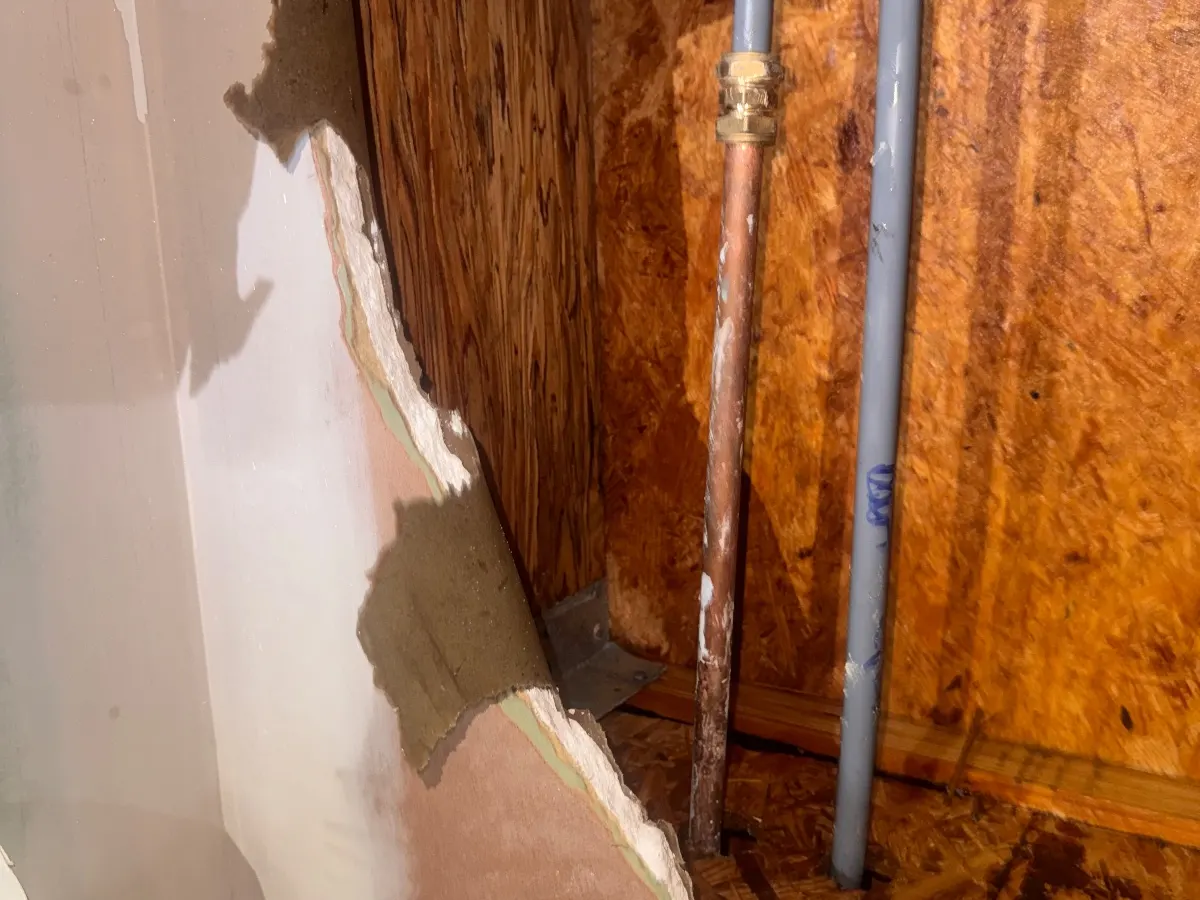
To fix a leaking radiator, find the leak point first: most leaks come from a valve, not the radiator. A weeping union nut or spindle usually stops with a quarter turn. A dripping bleed screw needs closing or replacing. A pinhole in the panel means internal rust: isolate it, patch it with epoxy putty and plan a replacement.
Where is the radiator actually leaking from?
Dry the radiator, both valves and the pipes below them with kitchen roll, then put a dry tissue against each joint in turn. The first tissue that comes away damp is your leak. Water runs downhill along pipework, so a puddle under the left valve can start at the top of the radiator. Check with the heating off and again with it running, because some joints only weep when hot and expanded.
The leak will be at one of five places, and each has a different fix:
- The union nut, the large nut joining the valve to the radiator tail. The most common leak on older radiators.
- The valve spindle, where the TRV head or lockshield cap sits. Water creeps out around the stem when the gland packing dries out.
- The compression nut where the valve meets the pipe coming up from the floor.
- The bleed screw or the blanking plug at the top corners.
- The panel itself: a pinhole or a rust bloom along the bottom edge or a seam.
Radiator water is dirty and often black from sludge. It can stain carpets and floorboards for good, so put a tray or an old towel under the leak before anything else.
Is a leaking radiator an emergency?
A slow weep from a valve nut is not. A radiator dripping steadily onto a floor above a ceiling, or a leak that keeps dropping your boiler pressure, becomes one overnight. On a combi or system boiler the heating is a sealed circuit, so every drop that escapes lowers the pressure. Once the gauge falls below roughly 0.5 bar, most boilers lock out and you lose heating and, with a combi, hot water too.
If you cannot slow it down, or the water is reaching a ceiling below, isolate the radiator using the steps further down, switch the boiler off and get help. Our radiator repair visit starts with the £60 call-out at any hour, and the repair price is agreed with you on site before any work starts. If water is already coming through below, see a ceiling leak under the bathroom for how to protect the room.
Tightening a leaking valve nut or spindle
For the union nut or the pipe nut, use two spanners: one holding the valve body still, the other turning the nut clockwise. A quarter turn is enough. Without the second spanner the whole valve twists, strains the pipe below and often opens a new leak under the floor. An adjustable spanner is fine if its jaw opens wide enough; radiator union nuts are commonly around 30mm across the flats.
For the spindle, pull off the lockshield cap or the head of an older wheelhead valve. Under it is a small gland nut around the stem. Tighten it an eighth to a quarter of a turn and check the valve still turns. A TRV body usually has no gland nut to tighten: if water appears around its pin, the pin seal is worn. On many valves the pin gland is a cheap screw-in part that can be swapped without draining, with a towel under it for the drips; if the whole valve needs changing, that means draining down below it or freezing the pipe. That is a proper repair rather than a temporary one.
If a quarter turn does not stop the leak, do not keep going. An over-tightened olive on the pipe nut deforms and leaks worse, and a union nut that still weeps usually needs the tail resealing. Either way the fix means isolating and part-draining. Wrap a cloth around the joint, keep the tray under it, and check your boiler pressure each morning.
A leaking bleed screw or blanking plug
A bleed screw that drips has usually been left slightly open after bleeding the radiator. Close it with the radiator key, firmly but without forcing it. If it still weeps, the screw or its seal is worn. Bleed screws are sold in packs at DIY shops and swap in seconds, but only with the radiator isolated and the pressure let off, or you will get a jet of hot, black water.
The blanking plug in the opposite top corner seals with PTFE tape or a rubber washer. A weep here means resealing, which again needs the radiator isolated and drained below that corner.
How to isolate a leaking radiator safely
Isolating the radiator stops the leak while the rest of the heating keeps working. Turn the heating off and let the radiator cool. Close the TRV by turning it to 0. The snowflake setting on a TRV head is frost protection, not off, and many TRV heads do not fully shut even at 0, so if water still moves, take the head off and screw on the plastic manual cap that came with the valve, or press the pin down with the cap turned fully clockwise.
At the other end, pull the cap off the lockshield valve and turn the spindle clockwise with a small spanner until it stops. Count the turns as you go and write the number down. That number is the balancing setting; open it by the same amount afterwards or the radiator will heat unevenly.
With both valves shut, the radiator holds only what is inside it. For a panel leak you can drain it by loosening a union nut slightly over a tray, with the bleed screw opened a little to let air in. For a double-panel radiator that is several litres, so have a bucket and plenty of towels ready.
If either valve will not close, or the leak carries on with both shut, the leak is on the pipework or the valve itself. Leave the heating off and call someone out.
Patching a pinhole in the radiator panel
Pinholes are the radiator rusting from the inside. Steel panels corrode where sludge (magnetite) settles along the bottom, which is why the leak is nearly always low down. You can hold one temporarily: isolate and drain the radiator below the hole, sand the area back to bare metal, wipe it dry and press two-part epoxy putty over the hole. Leave it for the full cure time on the pack before refilling.
A liquid leak sealer added to the system is the other option on a sealed system. It works on small weeps and can buy weeks. It also circulates through the boiler, and the heat exchanger has narrow waterways, so read the boiler manufacturer’s guidance and our view on central heating leak sealer before using one.
Either way, a pinhole means the metal around it is thin. The next hole is usually close by. As a typical market range, a like-for-like steel panel radiator costs from well under £100 for a small single panel to a few hundred for a large double convector, plus the time to drain down, swap and refill. If more than one radiator is weeping, the water in the system needs cleaning and inhibitor adding, or new radiators will go the same way.
After the fix: top up the pressure and watch it
Any leak and any draining will have dropped the boiler pressure. With the system cold, top it up through the filling loop to the level in your boiler manual, usually between 1 and 1.5 bar, then bleed the radiator you worked on. If the gauge keeps falling after the leak looks dry, water is escaping somewhere you cannot see, often under a floor. A central heating pipe leaking under the floor covers the signs.
A temporary fix is for days, not months. Check it morning and evening with a dry tissue, keep the tray in place and book the repair before the next cold snap puts the heating under full load.
Questions people ask
Can I use PTFE tape to stop a radiator valve leaking?
Not from the outside. PTFE tape seals threads inside a joint, so it only helps when the joint is taken apart and remade. Wrapping it around a leaking nut does nothing.
Why is my radiator leaking only when the heating is on?
Metal expands as it heats, and pressure rises slightly, so a joint that is marginal when cold opens up when hot. It is usually a union nut or the valve spindle, and a quarter turn often cures it.
Is it safe to leave a leaking radiator overnight?
A slow drip into a tray is fine for a night if you check it and the boiler pressure stays up. A steady leak, or one near electrics or over a ceiling, should be isolated straight away.
Should I repair or replace a radiator with a pinhole?
Replace it. The pinhole shows the steel has corroded from inside, and patches only buy time. Valve leaks are different: those are worth repairing.