Leaks & burst pipes
Burst Pipe: What to Do Right Now
Published
When a water pipe bursts, shut the main stopcock, and if water keeps coming, close the loft tank valve or switch off the boiler, because those pipes are not fed by the mains. Make the electrics safe, drain the system through the taps, then hold the split with a repair clamp or tape until it is properly repaired.
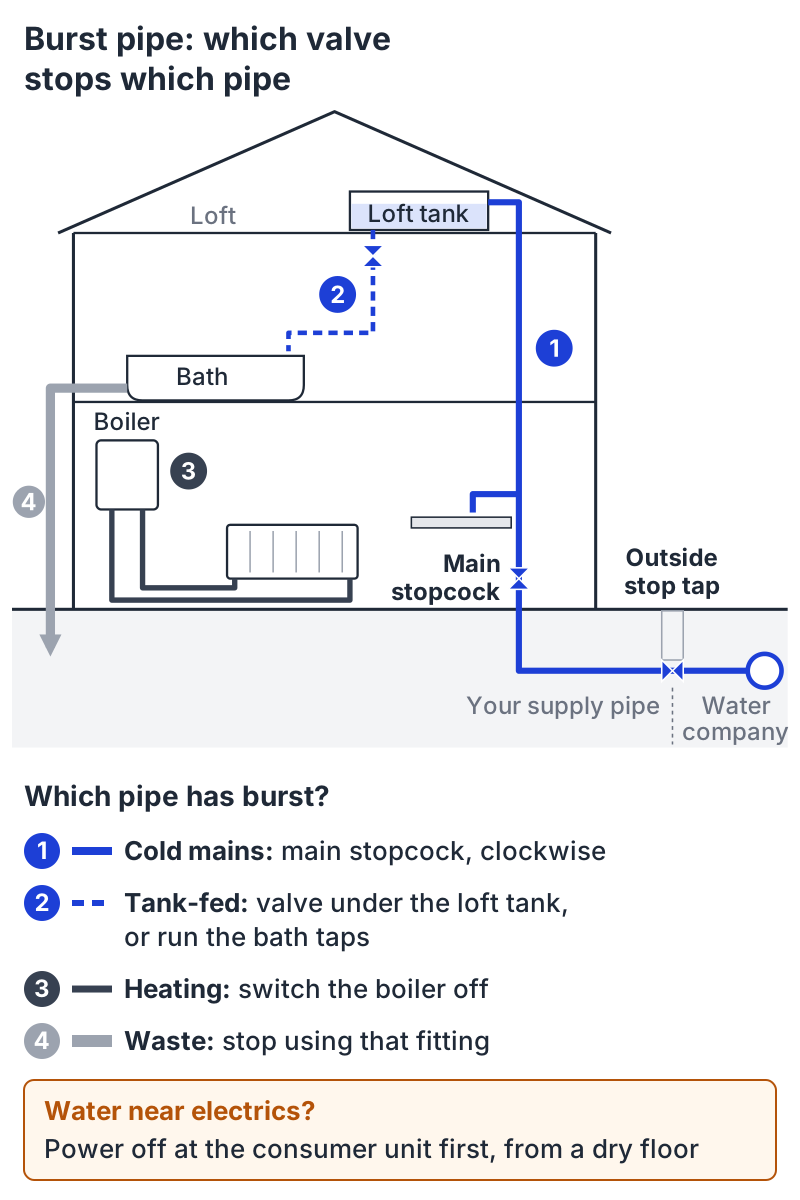
Which pipe has burst? It decides which valve you close
A house can have up to three separate water circuits plus its waste pipes, and a burst on each one is stopped in a different place. Look at the pipe that has split and at the water coming out of it.
- Cold mains pipe: full-pressure, clear, cold water spraying hard. The main stopcock stops it
- Tank-fed pipe in a house with a loft tank: lower pressure, still flowing after the stopcock is shut. Close the valve on the pipe leaving the tank, or run the bath taps to empty it
- Central heating pipe: warm or dark grey water, often near radiators or the boiler. Switch the boiler off. A sealed system slows once its pressure falls to zero; an open-vented one keeps drawing from the small feed and expansion tank in the loft until that tank empties, and with the mains stopcock off the tank can no longer refill
- Waste or overflow pipe: only leaks when a bath, basin or toilet is used, or when a cistern overfills. Stop using that fitting
If the burst is above or near a light fitting, a fused spur or the consumer unit, switch the power off at the consumer unit before anything else, provided you can reach it on dry floor. Never touch a wet switch.
Shut off the supply and drain the pipes
For a mains pipe, turn the stopcock clockwise until it stops. If you have never used it and it is stiff, steady pressure is safer than force; an old stopcock can shear. If it will not move, the outside stop tap under the small cover in the pavement or front path shuts the whole property off, and needs a long key that most hardware shops sell. Our guide to turning off a stopcock has photos of each type.
Then open the cold kitchen tap and flush the toilets to empty the pipework. On a combi system the burst will slow to a trickle within a few minutes. With a loft tank, keep the bath cold tap running until it stops.
Switch the boiler off as well. With the water off a combi cannot give you hot water anyway, and if the burst turns out to be on the heating side, a running pump keeps pushing water out of it. For the order of the first few minutes in full, see the first 10 minutes of a water leak.
Patch it for tonight: what holds and what does not
With the pressure off, a temporary patch can keep the rest of the house supplied until a proper repair. Which one to use depends on the pipe and the damage.
A pipe repair clamp is the most reliable. It is a hinged metal band with a rubber insert, sized for 15mm or 22mm pipe, that bolts tight over a split. It works well on a straight run of copper or plastic and will usually hold mains pressure overnight. Self-amalgamating silicone tape, stretched hard and wrapped at least half a width over each turn, is good for a pinhole or short split. Epoxy putty suits a weeping joint on a dry pipe but needs time to cure before the water goes back on.
None of these work on a pipe that has pulled out of a push-fit fitting, a split across a bend, or a joint that has blown apart. Those need the pipe isolated and left off. Temporary fixes for a leaking pipe explains how to fit each one, and why a clamp or tape is never the finished repair.
Where it burst changes what happens next
A burst in the loft is usually a frost split in a pipe feeding the tank or running to the cylinder. The water comes through the ceiling below, so check the ceiling before anything else and read emergency ceiling leak repair if it is bulging.
Under a suspended timber floor, the first sign is often water pooling at the skirting or a damp patch spreading across a carpet. The pipe cannot be reached without lifting boards, so this is rarely a DIY patch job. The same goes for heating pipes buried in a concrete screed, where a heating pipe leaking under the floor needs tracing before anything is dug up.
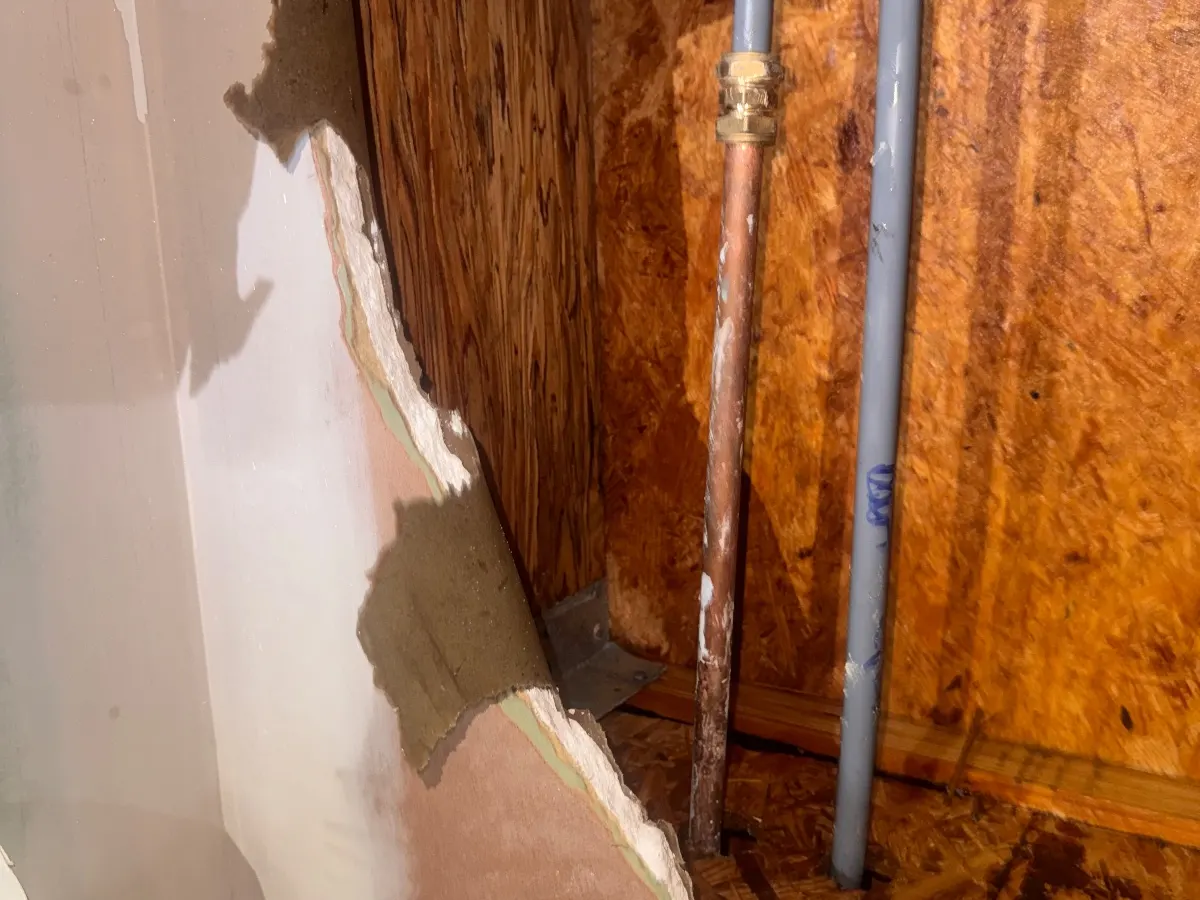
Inside a wall, the pipe has often been pierced by a nail or screw, sometimes years before. It may have seeped slowly and then opened up. Leave the fixing in place until the plumber arrives, because pulling it out can turn a seep into a jet.
Outside, before the house, a split on your underground supply pipe shows as wet ground on your side of the boundary stop tap. Water bubbling up in the pavement or road on the far side is the water company’s pipe, and it is theirs to fix. The split is explained in who fixes a burst water main in the street.
What the engineer does to repair it properly
The engineer confirms the supply is fully isolated, then cuts out the damaged section with some sound pipe either side of the split, because frost and corrosion rarely damage only one spot. On copper, a new length goes in on compression fittings, soldered joints or a slip coupling where the pipe cannot be sprung apart. On plastic, a new length is fitted with push-fit connectors and a pipe insert in each end.
The water is turned back on slowly so air is pushed out through the taps, and the new joints are checked under full pressure. If it was a heating pipe, the system is refilled, the radiators are bled and the pressure is set back to about 1 to 1.5 bar cold. A frost split in an unlagged loft pipe will happen again, so you will be told whether that run needs lagging or rerouting.
Our burst pipe emergency repair visit follows that pattern. The £60 call-out covers getting an engineer to you at any hour, and the repair price is agreed with you on site before any work starts.
After the repair: drying out and the insurer
Burst pipes are normally claimed as escape of water on a buildings or contents policy. Ring the claims line before paying for more than an emergency repair if you can, and keep the plumber’s invoice, the photos you took and any damaged pipe section. Many policies cover the damage the water caused but not the pipe repair itself, so read the wording.
Keep the heating on low and windows open a crack to dry the house out. Plaster that stays damp for weeks grows mould, and wet floorboards can cup. If electrics got wet, have the circuit checked by an electrician before using it again.
Questions people ask
Why is a burst pipe still leaking after I turned off the stopcock?
Either the pipes have not drained yet, or the burst is on a tank-fed or heating pipe that the mains stopcock does not supply. Open the taps, close the valve under the loft tank and switch the boiler off.
Can I turn the water back on after a burst pipe?
Only once the burst section is isolated or firmly clamped. If a valve can cut off just that run, close it and restore the rest of the house. If not, leave the stopcock off until the repair.
How long will a repair clamp hold?
A properly fitted clamp on a straight run of pipe can hold for days, but it is a temporary fix. It can creep under pressure changes, so replace it with a permanent joint as soon as you can.
Is a burst pipe covered by home insurance?
The water damage usually is, as escape of water, on buildings and contents cover. The pipe repair, and damage from a slow leak, are often excluded. Check your policy and photograph everything first.