Leaks & burst pipes
Leak Under the Bathroom Sink
Published
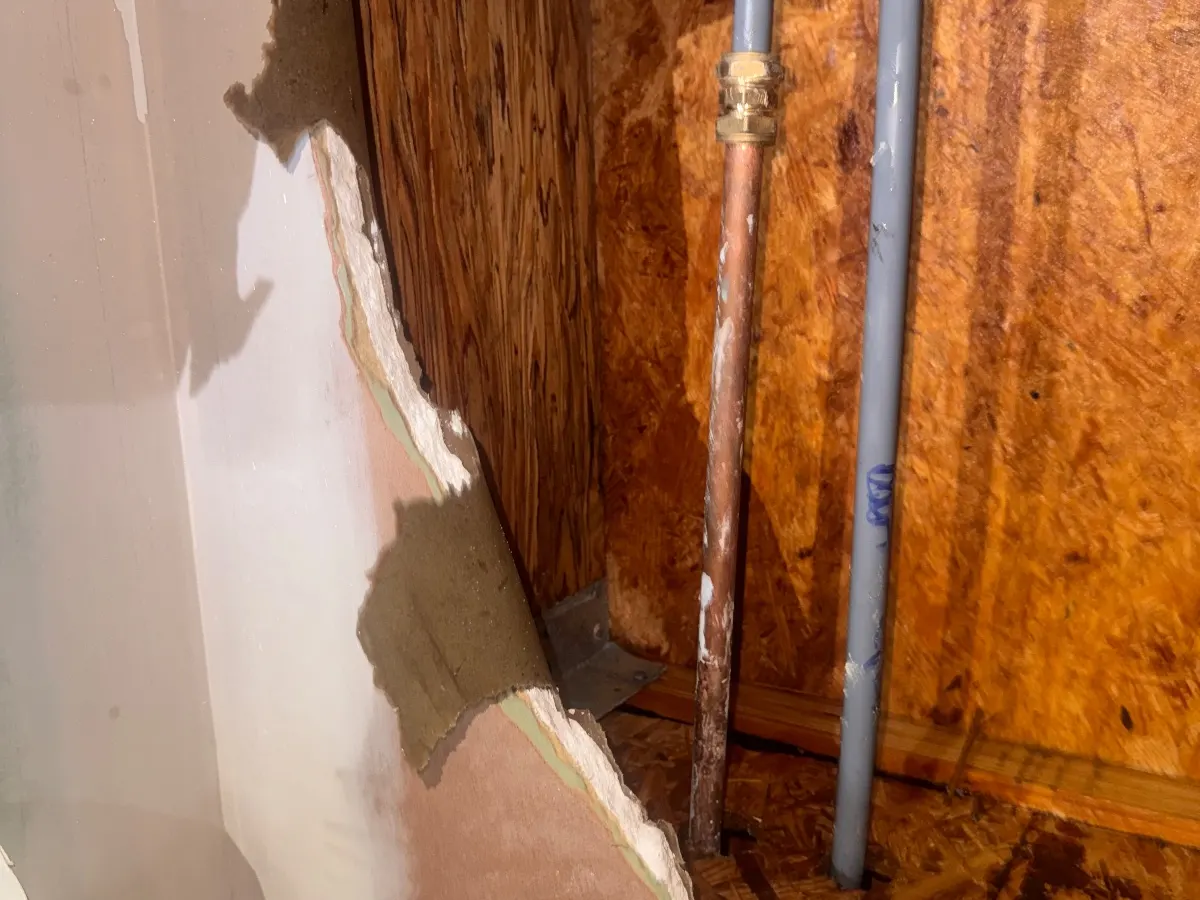
Under a bathroom basin the usual leaks are the pop-up waste where it seals to the basin, the bottle trap, and the thin flexible hoses feeding a monobloc tap. Waste leaks show up only when the basin drains; hose leaks never stop. Dry everything, run the basin in steps and the source normally shows itself.
What is under a bathroom basin
A bathroom basin has fewer parts than a kitchen sink, but they are packed into a smaller space, often behind a pedestal or inside a vanity unit. From the top down you will usually find:
- The waste: the plughole fitting, sealed to the basin with a washer and held by a back nut underneath. It is either a click-clack plug you press, or a pop-up plug worked by a lever behind the tap.
- The overflow: a channel moulded into the basin that drains into slots in the side of the waste. There is no separate hose as there is on a bath.
- The trap: usually a bottle trap, a compact cylinder with a screw-off base, or a tubular trap on older installations.
- The supply: two thin braided hoses from a single monobloc tap, or two tap connectors on separate hot and cold pillar taps, each fed by a pipe with an isolation valve.
Finding the leak in four steps
Get to the pipes first. In most bathrooms the basin is fixed to the wall and the pedestal only supports and hides the pipes, so it usually lifts or slides away once any silicone at its base is cut and any floor or wall screws are removed. Support the basin while you check the wall fixings are sound. In a vanity unit, empty it and use a torch.
Dry every joint, lay kitchen roll underneath and work through these:
- Nothing running for ten minutes: a wet patch means a supply hose, tap connector or isolation valve.
- Run the hot, then the cold tap with the plug out and watch the tap tails, not just the waste: water now flows through the waste and trap too, but a drip that runs down the tap tails is usually water escaping round the tap base and down the tap hole, not a hose.
- Fill the basin, then drain it: a drip only while draining is the waste seal, the back nut or the trap.
- Fill the basin until it runs into the overflow: a drip now, and not before, is water getting past the waste washer at the overflow slots.
Pop-up and click-clack wastes
Many pop-up wastes with a lever behind the tap have a horizontal rod that enters the side of the waste through a small ball joint. That joint has its own seal and a nut, and it drips when the basin drains. Nip the nut up a little by hand. If it keeps weeping, the seal inside needs replacing, and it is usually simpler to fit a new waste.
On any waste, a drip from under the basin where the waste meets the ceramic means the washer under the flange or the back nut has failed. Older wastes were bedded on plumber’s putty or silicone; newer ones use rubber washers. Refitting means undoing the back nut, lifting the waste out, cleaning off old sealant and refitting with fresh washers. A new basin waste is typically a £10 to £30 part.
One mistake worth checking: a basin with an overflow needs a slotted waste, so the overflow can drain through it. An unslotted waste leaves water in the overflow channel, which can smell and drip back out through gaps around the waste. If you are fitting a new one, match it to the basin. A leaking basin waste goes further into the refit.
The bottle trap and waste pipe
Bottle traps collect hair and soap, and a partial blockage raises the water level inside until it pushes past a worn seal. Put a bowl underneath, unscrew the base by hand and clean it out. Check the rubber seal in the base and the washer where the trap meets the waste. Refit hand-tight: plastic trap nuts crack if you use grips on them.
Behind the trap, the waste pipe usually runs into the wall or down through the floor. A solvent-welded joint that has pulled apart, or a push-fit joint that has lost its seal, will drip only when water runs, and the drip can run back along the pipe to appear somewhere else. If water appears where the pipe enters the wall, see a leaking waste pipe.
Tap hoses and connections: the leak that does not stop
A monobloc basin tap is fed by two short braided hoses screwed into its base. They sit under pressure all the time, from the mains or the hot water cylinder, and the connection into the tap body is small and easily cross-threaded. Look for rust in the braid, green corrosion at the ends or a hose that has been bent sharply against the wall. On pillar taps, the tap connector nut under the basin can weep where it meets the tap tail.
Close the isolation valve on the leaking side with a flat screwdriver, slot across the pipe. If the valve will not turn, or there is none, close the main stopcock. Replacing a basin tap hose means unscrewing it from the tap body under the basin, which is fiddly and easy to overtighten. If water is coming from the tap itself above the basin, that is a leaking tap repair, not a pipe leak.
Water that has been sitting in a vanity unit for weeks swells the chipboard base and can hide a leak into the floor. If the unit base is soft or crumbling, check the floor below and the ceiling of the room underneath.
When to call a plumber
Get someone in if the leak is on the supply side and will not isolate, if the basin or pedestal is loose on the wall, if the basin itself is cracked, or if a stain has appeared on the ceiling below. A plumber will usually replace a failed tap hose and any stiff isolation valve together, and refit or renew the waste and trap in one visit, which avoids coming back for the next weak part.
Our leak repairs service covers basins at any hour. The £60 call-out gets someone to you, and the repair price is agreed with you on site before any work starts. For the kitchen equivalent, see a pipe leak under the kitchen sink.
Questions people ask
Why does my bathroom sink leak only when I drain it?
The water is getting past the waste seal, the back nut, the pop-up rod joint or the bottle trap. None of those carry water until the basin drains, so the drip only appears then.
Why is there water under the basin when nobody has used it?
Something under mains pressure is leaking: a braided tap hose, a tap connector or an isolation valve. Close the isolation valve on that side or the stopcock, because this kind of leak does not stop on its own.
Can I remove a basin pedestal to get to the pipes?
Usually yes. The basin is fixed to the wall and the pedestal supports and hides the pipes. Cut any silicone at the base, undo any floor or wall screws and ease it out, supporting the basin as you do.
Do I need a slotted or unslotted basin waste?
Slotted if the basin has an overflow, so water in the overflow channel can drain away. Unslotted only for basins without one.