Leaks & burst pipes
Water Leak Inside a Wall: Signs and Next Steps
Published
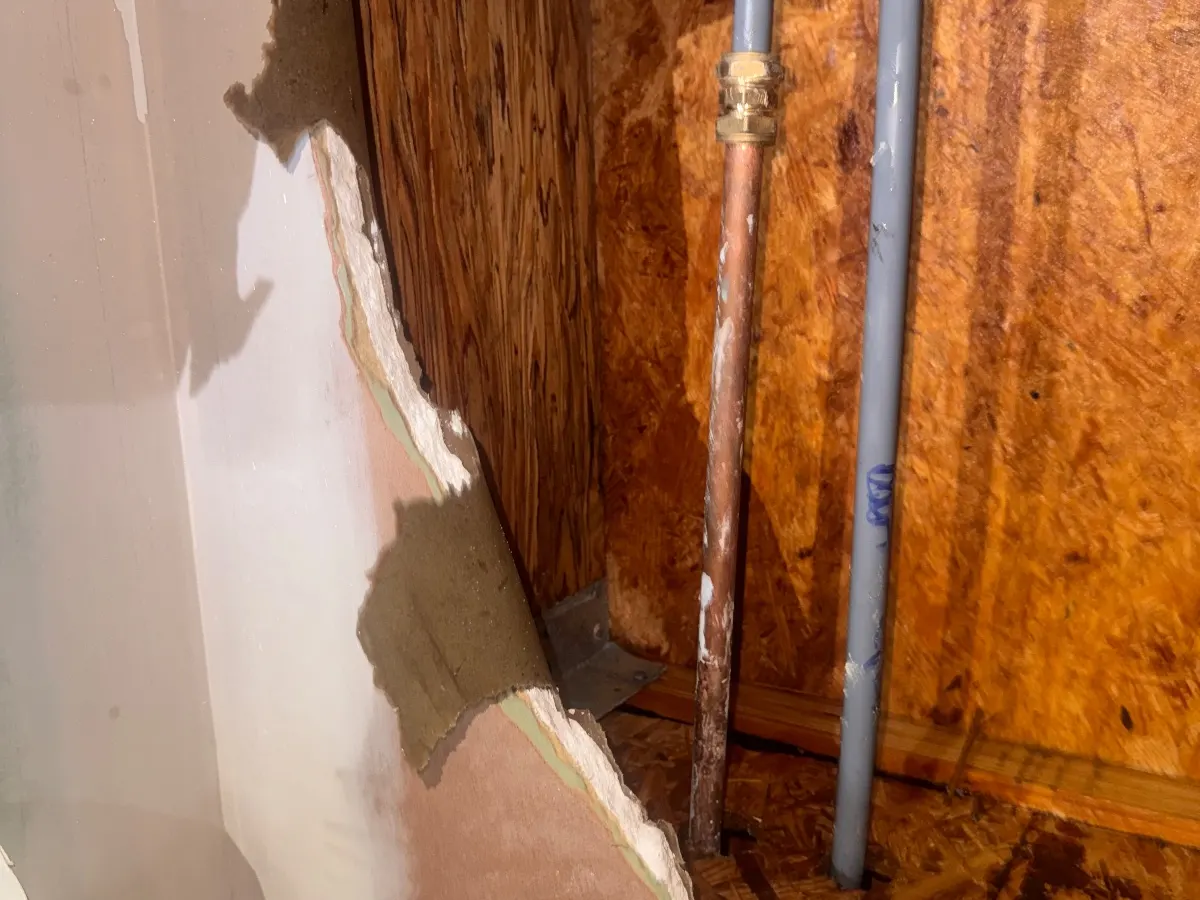
A water leak inside a wall shows as a damp patch that keeps spreading, bubbling paint or wallpaper, a swollen skirting board, a musty smell or a hiss with every tap off. Confirm it with your water meter, or the boiler pressure gauge for a heating pipe. If either shows a loss, turn the water off and get it traced.
The signs, from earliest to latest
Water in a wall cavity or behind plasterboard can run for weeks before it shows, so the early signs are easy to dismiss. These usually appear in roughly this order.
- A faint hiss or trickle at night when the house is quiet and no water is running
- A water bill or meter reading that has crept up for no reason
- A musty smell in one spot, often inside a built-in cupboard
- Paint that bubbles or wallpaper that lifts at a seam
- A darker patch that feels cool to the touch, with a tide-mark edge
- Skirting boards swelling or splitting, or laminate or carpet damp at the wall edge
- Black mould spots on the wall surface or behind furniture
- Crumbling plaster, or a floor below the wall that sounds hollow
Prove it is a pipe before anyone opens the wall
Damp on a wall has many causes, and only some of them are plumbing. Two cheap tests tell you whether water is escaping from your pipes.
For the cold mains and anything fed from it, use the water meter. Turn off every tap, the washing machine, the dishwasher, the fridge water feed and any outside tap. Make sure no toilet cistern is filling. Read the meter, use no water for half an hour and read it again. Any movement means water is leaving the pipework somewhere. If you are not metered, listen at the internal stopcock with everything off: a steady hiss is water flowing. Our guide to a meter running with no taps on goes through the edge cases.
For central heating pipes, watch the boiler pressure gauge. A sealed system should hold its pressure, usually between 1 and 1.5 bar when cold, for months at a time; most need topping up only once or twice a year. If you have to keep topping it up, there is a leak on the heating circuit, and pipes buried in walls and floors are a common place for one. See boiler losing pressure every day.
If both tests are clean and the patch is still there, the cause is probably not a pipe.
If water is running near a socket, switch or light fitting in that wall, switch off the circuit at the consumer unit before you touch anything, if the unit itself is dry and nowhere near the wet wall.
Pipe leak, rising damp or condensation?
The shape and position of the damp point to its source.
A pipe leak tends to make a patch that is wettest in the middle and dries toward its edges, sits in line with a tap, radiator, boiler or bathroom on the other side of the wall, and keeps spreading whatever the weather. Wet patches that run in a straight line, horizontally or vertically, often follow the route of a pipe.
Rising damp sits at the bottom of a ground-floor wall, usually no higher than about a metre, with a salty, fluffy tide line. It stays roughly the same size over time and does not respond to turning the water off.
Penetrating damp comes in from outside through a gutter leaking at one of its joints, a cracked render or failed pointing, and gets worse after rain. Condensation appears on cold outside walls, in corners and behind wardrobes, and is worse in winter. For damp that shows on ceilings, see water spots on the ceiling.
What to do while you wait for help
If the meter test shows a loss and the damp is spreading, turn off the water at the stopcock. If you only need water in the evening, turn it back on briefly and off again afterwards. That limits the damage without leaving you without water altogether. Our guide on how to turn off a stopcock helps if it is stiff.
For a heating pipe leak, turn the boiler off and do not keep topping up the pressure. Each refill pushes more water into the wall and brings fresh oxygen into the system, which speeds up corrosion in radiators.
Move furniture away, lift rugs, and photograph the wall and the meter readings with the date. Your buildings insurer will want these, and many policies include trace and access cover that pays for finding the leak and opening the wall to reach it.
How a leak inside a wall is found and fixed
A good engineer finds the leak before cutting anything. They trace the likely pipe routes from the stopcock, the boiler and the fittings, confirm damp levels with a moisture meter, and use a thermal camera to follow a hot water or heating leak as a warm streak through the plaster. Isolating sections one by one, using isolation valves or by closing radiator valves, narrows it further. The aim is one small, precise opening instead of a trail of exploratory holes.
The same few spots account for most wall leaks. Behind a built-in shower valve, where the hot and cold pipes and their joints sit in the wall. Where radiator pipes drop into a wall or floor under the valve. Behind a kitchen sink, where the supply pipes to the taps and the washing machine valve run through a cupboard back. And around a boiler, where heating and hot water pipes run down to the floor. Starting at those points saves a lot of opening up.
Under Schedule 2 of the Water Supply (Water Fittings) Regulations 1999, no water fitting should be embedded in a wall or solid floor, and no joint should be concealed, which the regulations define as buried, enclosed in a chase or duct, or anywhere access is difficult. Many older London homes have copper pipes plastered straight into the wall, often with a joint hidden somewhere along them, which is exactly where leaks appear. A good repair reroutes the pipe on the surface, or puts any joint behind a removable access panel, rather than burying a new one in the plaster.
You pay the £60 call-out, and the repair price is agreed with you on site before any work starts. As a typical market range, finding and repairing a leak in a stud or plasterboard wall often costs a few hundred pounds, with the plastering and decorating on top. A leak in a solid wall or under a tiled surface costs more, because more has to be opened and made good. To book, see emergency leak repairs.
Questions people ask
How do I know if a pipe is leaking inside my wall?
Turn off every tap and appliance and watch the water meter for half an hour. If it moves, water is escaping. Match that with a spreading damp patch, bubbling paint or a hissing sound to place it.
Is a leak inside a wall an emergency?
It is if the damp is spreading quickly, water is near electrics, or the ceiling or floor below is getting wet. A slow weep can wait for a daytime visit, but turn the water off between uses until then.
Will home insurance pay for a leak inside a wall?
Many buildings policies cover sudden escape of water and the cost of tracing and reaching the leak. Gradual leaks and the pipe repair itself are sometimes excluded, so check the wording and report it early.
Can a leak in a wall cause mould?
Yes. Wet plaster and timber grow mould within days. Once the leak is fixed, the wall needs to dry fully before redecorating, which can take several weeks for solid masonry.